When I wrote last month about 'The Difference Between' the various grades of nurse, I put:
The grade of 'Assistant Nurse' became increasingly common, and these were women who had previously undertaken formal nurse training, but not to a standard sufficient to join Queen Alexandra's Imperial Nursing Service Reserve or the Territorial Force Nursing Service. They were women who had completed a set training as a fever nurse, a children's nurse, in a women's hospital, or as a midwife. Their pay fell half way between that of the VAD and the trained Staff Nurse, and they were likely to be given more responsibility in line with their training and experience.
While transcribing the war diary of the Matron-in-Chief with the British Expeditionary Force, I've now come across entries which show that this changed in 1918. The diary entry states:
V.A.D. Assistant Nurses: Received from Director General Medical Services copy of Army Council Instruction 214 of 1918 relating to the promotion of V.A.D. Members to the rank of
Assistant Nurses. Before being promoted they must have served two years, must be in possession of the Red Efficiency Stripe and must be recommended by the Officer Commanding and Matron. The letters "A.N." are to be worn on the apron in indoor uniform and on the shoulder straps on outdoor uniform.
The Red Efficiency Stripe was awarded to VAD members who had completed 13 months continuous service in a military hospital under the control of the War Office, and who had satisfactory confidential reports by their Matron and Commanding Officer. After another years' service they could qualify for a second stripe. These stripes should not be confused with the white stripes often seen on the sleeves of VADs, which signified length of service alone, not that they had necessarily reached a high standard in their work [although of course they might have done!].
Wednesday, 18 April 2007


Friday, 6 April 2007
Who has the truth?
I’ve got used to reading a fair amount of inaccuracy about nursing during the Great War. Well, that’s not quite true – I almost expect it now, although I’ve never got USED to it – and when I come across bits that are blatant rubbish, they really rankle, especially if they’re written by academics, as these are the accounts that may well be digested and then repeated as the absolute truth.
As a member of the Royal College of Nursing, the newsletter of the associated History of Nursing Society dropped through my letter box last week. Inside was a short article written by a prominent member of the nursing profession, titled ‘Who has the truth?’ In it she expresses regret that the health care professions are failing to keep much of their paperwork and written archive material, and also of the transient nature of electronic sources which are too easily deleted, a process that she describes as ‘throwing our “truth" away’. She makes a comparison with the diaries and letters retained by Vera Brittain, which allowed her, nearly two decades later, to ‘write an accurate testimony’ of her life as a VAD during the Great War.
How accurate those original diaries were, and whether we are throwing out history away now, any more than we did a hundred years ago, are both subjects which could be long debated, but I was interested in one paragraph, in which she writes:
A Testament of Youth kept us fixed to our TV screens in the 1970s as we followed this amazing woman through her Voluntary Aided Detachment (VAD) experiences in the First World War. Through her memory, supported by diaries, letters and “artefacts”, she gives subsequent generations insight into the experience of living through those times. She lost her fiancé, her brother, their friends and many, many patients. She nursed on the Western Front, in Malta and everywhere in between in field ambulances and hospital trains.
That last sentence made me sit up and take notice, and, very concerned that my memory might be failing me in advancing years, it had me running to grab my copies of “Testament of Youth” and “Chronicle of Youth.” Vera Brittain certainly served on the Western Front and in Malta, but where was this ‘everywhere in between’ that is mentioned. No VAD member working under the auspices of the War Office [as Brittain was] ever served in a casualty clearing station, let alone a field ambulance, their service being restricted to military hospitals only, and military ambulance trains carried a staff of three trained nurses, not VADs. So did VB make any claims in her writing to working in field ambulances or on ambulance trains? Did the filmed version of “Testament of Youth” use artistic licence to include scenes that could not be substantiated by original sources? Or has the writer included that sentence to make more interesting reading without having intimate knowledge of her subject? I’d be glad for any further insights into this.
‘Who has the truth?’
Friday, 23 March 2007
Marriage
I often see queries asking whether nurses serving with the British Army during the Great War could be married. The answer is, of course, rather a complicated one. Prior to the Great War, women training to be nurses were required to be either single, or widowed, although it was not too difficult for a married woman with no dependants and living apart from her husband to stretch the truth. But in general, nursing, like teaching, was a profession of single women, and they were required to resign their appointments on marriage.
At the outbreak of war, all the members Queen Alexandra’s Imperial Military Nursing Service, numbering just over 300, were single, and although there were a few members of the Territorial Force Nursing Service who were married, this had occurred during their civil employment, and on mobilisation many chose to resign, or were retained for home service only. The intention of the Matron-in-Chief at the War Office was to keep the services staffed by single women, but this proved to be impossible. By the middle of 1915 the shortage of trained nurses, both at home and abroad was acute, and it was obvious that it would be necessary to retain the services of women upon marriage, unless they wished to resign. At first they were sent home from France, for ‘Home Service only’, and Maud McCarthy, the Matron-in-Chief with the British Expeditionary Force thought that she would never get hard work and devotion to duty from women who had more than nursing on their minds. She was particularly opposed to married nurses and VADs who wished to work in France because their husbands were serving there, and described them as women with ‘their baggage at the Front.’ As the manpower shortage increased, marriage was looked upon rather more benevolently, and it was eventually agreed that as long as a woman informed the military authorities of her forthcoming marriage; observed all the correct formalities, and had good reports, she would be allowed to continue to serve, and remain overseas if she wished. Any woman who went on leave, and married in England without permission, would find herself looked on unfavourably, and probably refused permission to return to France, especially if she was a VAD, who were more easily recruited and not in such short supply.
Reading through the war diary of the Matron-in-Chief, it often seems as though there were many marriages happening at extremely short notice – the sort of ‘spur of the moment’ occurrences that wartime is famous for. I suspect that the phrase ‘marry in haste, repent at leisure’ haunted many a nurse throughout her life! And if the British military nursing authorities seemed very straight-laced about marriage, they could not compare with the Australians. Until the middle of 1917, a member of the Australian Army Nursing Service did not even have to bother to resign on marriage, as at that point her contract was automatically terminated, and she was returned to the UK, to continue her life as she chose – but of course, eventually the shortage of trained nurses changed that as well, and marriage became a necessary wartime evil for the AANS.
After the war, as the demobilization of nurses working on the QAIMNS Reserve was complete, the service returned to one of single women, a situation which lasted until the 1970s. Even married members of the Territorial Force Nursing Service, who returned to their civil employment, were not allowed to remain in the service – what was useful in wartime was found unacceptable in peacetime.
Tuesday, 6 March 2007
The Difference Between...
Having written about the WO399 run of files at The National Archives, it's worth mentioning that included among them are some records relating to untrained nurses; VADs, Special Probationers and Assistant Nurses who worked in military hospitals [rather than Red Cross hospitals] during the war. Why some files have been retained isn't clear, but all those that I've come across refer to women who were employed in Territorial General Hospitals in the United Kingdom - some of them later went on to work abroad, but most started off serving alongside the Territorial Force Nursing Service. So although a long shot, it's always worth checking for an untrained nurse in the WO399 index at The National Archives. The 'VAD' is familiar, but what were the differences between her, and the less common Special Military Probationer [SMP] and the 'Assistant Nurse'?
VADs were employed by the British Red Cross Society through their headquarters at Devonshire House, and the majority worked in Red Cross and auxiliary hospitals, but if employed in British military hospitals at home or abroad, they would work under the control of the War Office, and take their day to day orders from the Matron of their hospital or her deputies.
Special Military Probationers were also untrained, and the terms and conditions of their contracts were virtually identical to those of the VAD. But they were employed by the War Office specifically to work in military hospitals, and had no connection with the BRCS. There is some evidence to suggest that the War Office did some 'cherry picking' - during the 3 month initial training undertaken by VADs in civil hospitals from 1915 onwards, some of the most able were offered contracts as SMPs, and the result was the perception that these 'War Probationers' formed a more elite group than the VADs. In fact, except for the difference in employers, their contracts and conditions of service were identical, but there always remained the inference that those employed by the War Office were superior as nurses.
As the need for trained nurses grew during the war, shortages began to cause great difficulties, particularly overseas, where the need for skilled nurses in forward areas resulted in Base hospitals becoming top heavy with VADs, and seriously lacking in experienced women. The grade of 'Assistant Nurse' became increasingly common, and these were women who had previously undertaken formal nurse training, but not to a standard sufficient to join Queen Alexandra's Imperial Nursing Service Reserve or the Territorial Force Nursing Service. They were women who had completed a set training as a fever nurse, a children's nurse, in a women's hospital, or as a midwife. Their pay fell half way between that of the VAD and the trained Staff Nurse, and they were likely to be given more responsibility in line with their training and experience.
As the war progressed, there were certainly VADs who became very skilled nurses and took on great responsibility. Many had hopes that their wartime work would qualify them for a reduced training as a nurse after the war, and that was a question that caused great unrest and discussion within the nursing profession. And was definitely not to be...
Tuesday, 27 February 2007
Nurses' Service Records at TNA
Class WO399 at The National Archives contains all surviving service records for members of Queen Alexandra's Military Nursing Service, the QAIMNS Reserve and the Territorial Force Nursing Service who served during the Great War. In all, there are 15,792 files in WO399, but there are a number of files missing from the run which were destroyed during the 'weeding' process of the early 1930s. At that time all the files were thinned out, and most now contain only a selection of papers, mainly relating to things such as pensions and gratuities.
But quite a number were totally destroyed - no-one really knows how many, or why certain files were chosen for destruction, while others survived. It's been suggested that there might be as many as 5,000 missing, but I find that difficult to believe, otherwise I would find that about 1 in 4 of those I look for are missing, which just isn't the case. I frequently draw a blank with service records, without understanding the reason, but recently I've failed to find a couple, which has proved quite helpful in one way, as it's highlighted one class of woman whose files are likely to have been scrapped. Both these women were members of the Territorial Force Nursing Service; they served during wartime, but were discharged from the service soon after the war; they had no entitlement to pension, and they both died during the 1920s from causes unrelated to their war service. As they were not going to serve at any time in the future, no pensions, and a non-attributable cause of death, it looks as though retention of their service files was considered unnecessary.
It will be interesting to try and pinpoint other groups of women whose files were similarly afflicted - finding a whole missing group would be a useful aid understanding the system.
Thursday, 22 February 2007
Heilly Station
When I'm in France I try to visit some of the places that were home to Casualty Clearing Stations and hospitals during the Great War. They are now quiet retreats, and off the route normally taken by visitors to the battlefields, giving no hint of what toil and drama took place there. One of my favourites [if that's the right word] is Heilly Station, situated at Mericourt-l'Abbe, just north of the River Somme, and about 6 miles south-west of Albert. In July 1916, during the first days of the Battle of the Somme, the CCSs at Heilly were closest to the battlefield, but the last on the route taken by ambulance trains on their journey taking casualties back to hospital. They admitted thousands of men during those first few days, but the shortage of trains meant that no casualties could be evacuated for more than 72 hours. During that time, the death toll at Heilly was so great, that to save both time and space, men were often buried on top of each other, three to a grave. As there was so little room on each headstone for three names, the regimental badges of the soldiers had to be omitted, and instead the insignia of 117 separate units are incorporated into a cloister and screen wall at one end of the cemetery.
Heilly today seems a hauntingly sad place, in countryside that looks untouched by tragedy. But life goes on, and when I was there last year, the station-master was proud to tell us that his station is on the present day route of the TGV [Train Grand Vitesse] and also sees the Orient Express go through twice a week [once each way], although neither actually stop there. No more casualties in or out of Heilly Station! He also said that field walking constantly turns up mementoes of those wartime days.
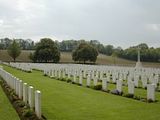
So here is Heilly today, the station; the site of the casualty clearing stations, and the military cemetery, the last resting place of 2,890 Commonwealth soldiers, and 83 Germans.
Just click on the photos to enlarge them



**************
Heilly today seems a hauntingly sad place, in countryside that looks untouched by tragedy. But life goes on, and when I was there last year, the station-master was proud to tell us that his station is on the present day route of the TGV [Train Grand Vitesse] and also sees the Orient Express go through twice a week [once each way], although neither actually stop there. No more casualties in or out of Heilly Station! He also said that field walking constantly turns up mementoes of those wartime days.
So here is Heilly today, the station; the site of the casualty clearing stations, and the military cemetery, the last resting place of 2,890 Commonwealth soldiers, and 83 Germans.
Just click on the photos to enlarge them
Heilly Station today - some of the smaller buildings were there during the Great War

And the view behind the station towards the fields that were home to three casualty clearing stations in 1916

Those vast expanses of land, so peaceful now, and giving no hint of a desperate former life

At the end of the site is the British cemetery

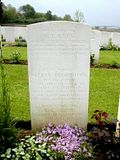
This is one of the many single graves containing three burials, but no room for regimental badges

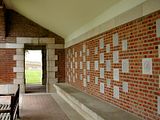
And the cloister wall, with some of the 117 badges which couldn't be included on the headstones

**************
Saturday, 17 February 2007
Where on earth was that?
If you've found mention of a hospital or casualty clearing station in France and Flanders by it's number, and have no idea where it was situated, there is a way to track it down. In 1923, the Ministry of Pensions published a booklet entitled:
'Location of Hospitals and Casualty Clearing Stations: British Expeditionary Force 1914-1919'
and it's now available online here:
http://www.vlib.us/medical/CCS/ccs.htm
It's quite a long document, and it takes some scrolling up and down to find what you're looking for, and remember it only covers the Western Front, not any other theatre of war, such as Salonika or Mesopotamia. Also beware that there are quite a few errors and omissions - wrong dates, places, and in a few cases entire units missing. But still a really helpful publication.
As an anorak wearer of some distinction, I've put the information into five spreadsheets - hospitals by number, hospitals by location, and the same for the casualty clearing stations, with the fifth being for British Red Cross units. As I find more information, I can then add corrections, and have ended up with some very workable documents.
Well, if that's the sort of thing that grabs you ...
Subscribe to:
Posts (Atom)

