Monday, 30 July 2012

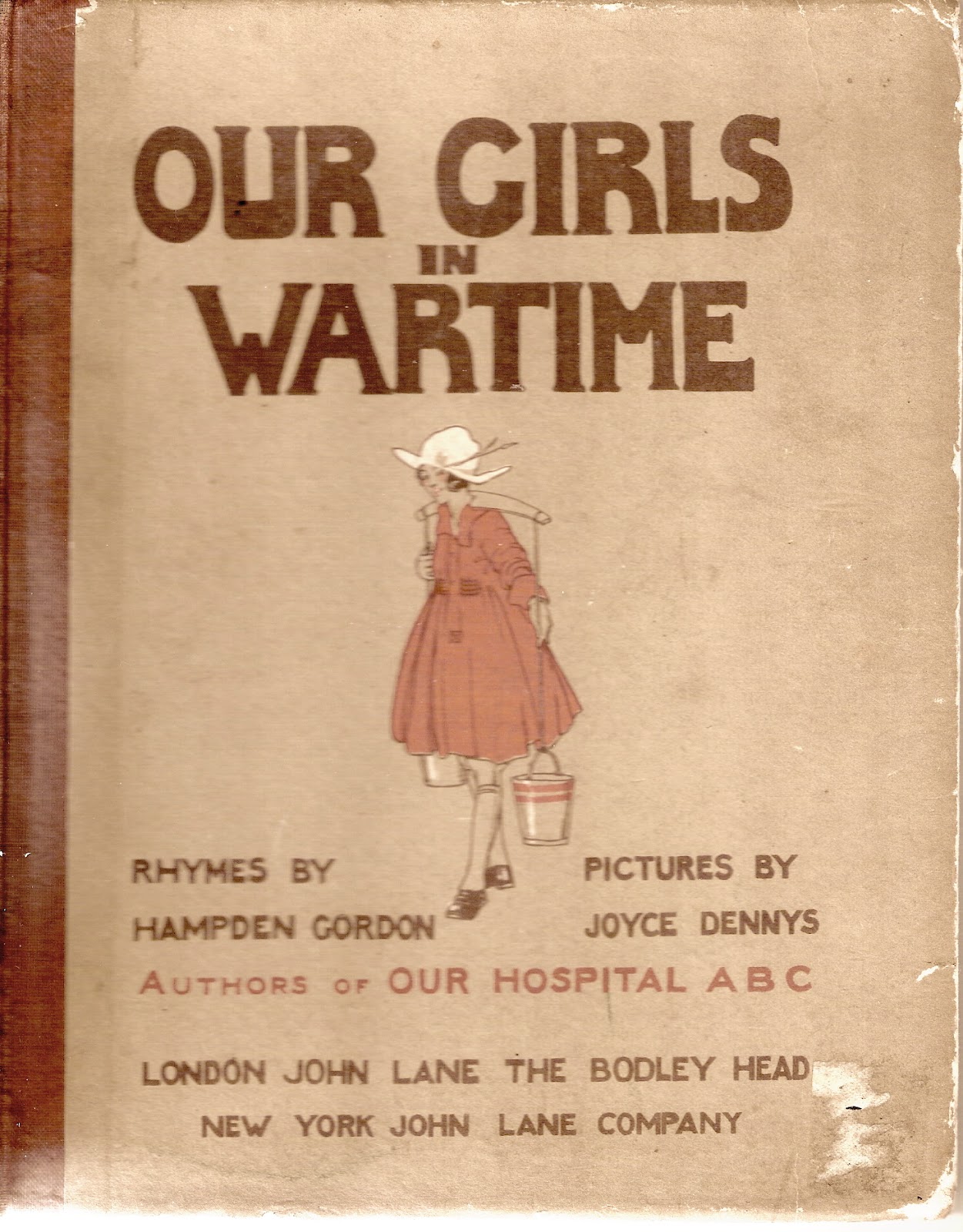
Our Girls in Wartime

Three years ago I added some images from 'Our Hospital ABC' here:

Our Hospital ABC

and was lucky enough recently to find a copy of its sister publication 'Our Girls in Wartime,' again with pictures by Joyce Dennys and rhymes by Hampden Gordon. So here are a couple of the pages with their rhymes:


***


Martha, a Munition-maker
Manufactures shells
Martha's Father is a baker:
Cakes are what HE sells.
Martha swears the shells she makes
Do more damage than his cakes ...
Perhaps.

***


Miranda mixed with all the Nobs;
Her Depot made a million swabs
(War Hospital Supply).
'It was the good hard work,' she said
'That turned my hair this vivid red.
Never, my dears, say dye.'

***

Thursday, 19 July 2012

Queen Mary's Hostel for Nurses


QUEEN MARY’S HOSTEL
The Nursing Times, 1 March 1919


     The work done by trained and untrained nurses in this war is a tale which is often told. A tale as yet untold is the fine work done for war nurses by Mrs. Kerr Lawson at Queen Mary’s Hostel for War Nurses, Bedford Place, London, one of the Hostels under the aegis of the British Red Cross Society. It falls to the lot of few women to have a grip – an unconscious grip – on the combined affection and admiration of hundreds of their fellow women. It points to some dominant quality which has so often belonged to some of our famous women leaders. The quality in Mrs. Kerr Lawson which holds other women was once expressed, more tersely and truly than she knew, by a Canadian sister: ‘That dear woman knows her job, and puts grit and love into it.’ The painful knowledge of the appalling burdens so many nurses are bravely and silently bearing came as a shock to Mrs. Kerr Lawson. The nurses with lightning intuition discovered that the right woman had been set down among them, and by degrees a never-ending stream of confidences relating to difficulties flowed to the superintendent in her restful study.  Mrs. Kerr Lawson found herself not only Superintendent of a Hostel, but the confidante of nurses, and very often the lifter of their burdens. There is a great freemasonry in trouble. Those who have received comfort have not been slow to speak.

     Queen Mary’s Hostel opened in Tavistock Place in the July of 1915 with free accommodation for twenty-three war nurses, irrespective of unit. The following July it was moved to Bedford Place with accommodation for thirty-five, though sometimes entertaining up to forty nurses. Two years later No.2 Hostel was opened at 52 Russell Square, for the Home Service Sisters of the British Red Cross, with twenty beds.  In the February of 1918 a No.3 Hostel was opened at 50 Warwick Square for all members of the nursing services who required to spend one night only in London. The mother-hostel had not been open for long before it gained the reputation it now holds so firmly. News of it travelled to Gallipoli, Alexandria, Cairo, Port Said, and to Mesopotamia, as well as to the great centres of nursing on the Western front.  When it is realised that all war nurses of the Empire are welcomed, irrespective of unit, the fascination of the contact with the women of far lands will be apparent. Those of us who have roughed it in home and foreign service appreciate to the full the home comforts in the hostels – the cosy bedrooms, the restful drawing-room, the well-cooked, daintily served meals – all the little thoughtful considerations following one’s kind welcome as an honoured guest.

     Owing to the generosity of theatrical managers outside recreation has not been lacking. The mental refreshment this has meant to tired women can be but dimly realised.  Our beloved Queen has taken a keen personal interest in the Hostel which bears her name, and has graciously sent gifts of flowers. On one of the occasions on which she visited the Hostel she addressed all the maids, and expressed her pleasure that they were working so happily and harmoniously in the common cause. Princess Mary is another Royal and welcome visitor.
‘How many of us have passed through this hostel?’ I once asked Mrs. Kerr Lawson.
‘About eight thousand.’
‘Then you have met a fairly representative crowd of us. What has struck you most about us, that is to say about the British nurses?’
‘The way in which some of you are putting up a fight against desperate odds, bravely and alone; the tragedy of those who have lost or are losing their precious health through war service, and who have others dependent on their earnings; the sad and bitter loneliness of those pushed through circumstances from their special home niche which, once having left, they never quite regain; and, above all, the scant means which so often renders them helpless when they should be independent.’ I knew this was cruelly true, and I thought of the spectre of Charity which is not always Love lurking for so many in days of misfortune behind the inadequate pay nurses receive for what is perhaps the most arduous but most devoted work in the world.
‘May you be given the strength to carry on; we sisters need women like you so sorely.’  A warm hand-clasp and I passed out, one more ship in the night, one which had received a God-speed from a very pleasant sport.

     The time has come when this clash of arms is stilled, when nursing sisters need tend the sad results of war but little longer. They will then disperse in their thousands and go their world-wide ways once more. What memories they will have stored, of battle on the land and in the air, and of perilous journeying on the seas – of the super-human endurance of our fighting men! Midst memories sad and drear will come one tender one – of the understanding woman, with true and steadfast eyes and mother’s heart, who gave to them the richness of her sympathy and to many a despairing nurse the strength to bear her load.

A. M. CAMERON

Wednesday, 18 July 2012

The Last Patient


Wednesday, 4 July 2012

Miss Shappere and the Royal Red Cross

While browsing through the tiny hand scribbled notes in the front of the Royal Red Cross Register, I came across one which reads:

'Miss Shappere was refused R.R.C. for service at Intombi Camp Ladysmith because her subsequent behaviour was not satisfactory'


As I'd never heard of Miss Shappere and was intrigued to know how she'd blotted her copy-book, I started with a web search which resulted in a fascinating insight into her life and work. Rose Shappere was an Australian nurse serving during the Boer War and this first newspaper item states quite clearly that she had been both mentioned in despatches (unproven) and that she had been awarded the Royal Red Cross 'which medal she now wears.'

Nurse Rose Shappere

But obviously not! This was written after her return to Australia, so I wonder if she had acquired a medal to wear that she was not entitled to, or if perhaps the newspaper just assumed on her say-so that she had received it. Other items such as this one give the impression that Miss S. was not shy of publicity:

Rose Shappere in London

There is also a good biography of Miss S. here:

Rose Shappere biography

So did mention of her 'subsequent behaviour' relate to indiscreet public comments about the conditions of the hospital at Intombi, or did she fall foul of the authorities in some other way? I shall keep my eyes open for any further references that I come across.

Sunday, 27 May 2012

Edith Hope, Naval Nursing Sister

I've always rather ignored Queen Alexandra's Royal Naval Nursing Service in favour of the Army, but earlier this month wrote about their service records which are at The National Archives.  I've now decided to index them, and although brief and scrappy at times, with none of the correspondence contained within the QAIMNS records, there are real gems to be found there. As I've previously transcribed the Royal Red Cross Register,* some of the names are familiar to me, but it's interesting to read additions in the service records which are not included in the RRC Register or London Gazette. One naval nursing sister, Edith Hope, joined in 1913, worked continuously until December 1929 when she retired from the service at the age of 49, and she received the RRC (2nd Class) in 1920 while working in the Royal Naval Sick Quarters, Shotley.  As soon as the Second World War started she decided to rejoin, and served from early 1940 until May 1946, by which time she was 66 years of age. Her ARRC was upgraded to the First Class award on 2nd June 1943, but no citation or details exist in the RRC Register - it just appears to be a general award for wartime service.  However, her naval service record is more forthcoming, stating:

To be a member of the Royal Red Cross for outstanding zeal, patience and cheerfulness and for courage and whole-hearted devotion to duty 

which is a very good addition to the other available information, and gives a much fuller picture of the woman herself.  The number of QARNNS service records is relatively small, but they add a great deal to the knowledge of military nurses of the last century. 


*Just to add a reminder that these records are now searchable on FindMyPast 

Thursday, 3 May 2012

A rose by any other name?


     I've recently been browsing through service records of members of Queen Alexandra's Royal Naval Nursing Service (and its predecessors).  The records are held in ledgers very similar to those held by the Royal Navy for all their officers and ratings, and although brief they offer insights into the women's personalities and capabilities not present in the thicker service files of members of the army's nursing service. They are judged on conduct, ability, zeal, tact in dealing with both staff and patients, and above all, 'temperament.'  The first four categories are marked on a scale covering 'poor' through 'average' and 'satisfactory,' to 'very good,' 'exemplary' and 'exceptional.'  Temperament, however, is a different matter. The varied and many words used to describe these women's 'temperament' is astonishing, but they give a wonderful view of the changes that can occur during a woman's long career, and how people's perception of character can vary. But to sum up, they were:

     Quiet, reliable, cheerful (so often 'cheerful'), pleasant, bright, energetic, equable (also 'very equable' and 'extremely equable'), alert, keen, ladylike, calm, willing, adaptable, contented and thorough.
Some were diffident, subdued, unassertive and changeable; placid, variable, reserved and moody. Some were many of these things at different times, or seen by one reporting officer as 'firm and thorough' while another viewed them as 'inclined to be domineering.'  A few were reported as 'casual and untidy,' 'not dignified,' or 'somewhat pessimistic and argumentative' and 'occasionally sarcastic.'  Whatever their strengths and weaknesses, for those women who reached the heady ranks of Matron, almost without fail their final assessments reported them as 'quiet and dignified' which seemed to be the most sought after trait of personality. Age may not have wearied them, but it did turn them into proper ladies.

Monday, 30 April 2012

Edith Appleton one more time!

I've written twice in the past about identifying nurses who were named in the wartime diaries of Edith Appleton, here:

Edith Appleton's diary 1

Edith Appleton's diary 2

Since re-reading the diary following its publication as 'A Nurse at the Front' a few more names have come to light so even more names to add now.  They are:

McCORQUODALE Janet
Born on 2nd December 1879 at Port Askaig, Islay, Argyllshire, the daughter of a lighthouse boatman.  She trained as a nurse at Stobhill General Hospital, Glasgow, between February 1912 and February 1915, before joining Queen Alexandra’s Imperial Military Nursing Service Reserve as a Staff Nurse a year later.  Her first posting was to Hampstead Military Hospital in June 1917, and she was later posted to France where she worked at No.3 General Hospital, Le Treport from May 1918 until February 1919.  Lighthouse-keeping must have run in the family as though her parents were both dead, her next of kin is given as her sister – the writing is difficult to read, but probably a Mrs. Thomas, whose address was Montrose Ness lighthouse (Scurdie Ness), Montrose, Scotland.

SUMMERS, Marian
Born 27 July 1892 at Kingstone, Barnsley, Yorkshire, her father a ‘Colliery Salesman and Commercial Traveller.’  She trained as a nurse at Victoria Hospital, Burnley, between March 1913 and April 1916, and joined Queen Alexandra’s Imperial Military Nursing Service Reserve as a Staff Nurse a year later.  At the time of joining, her parents were still alive and living at 35 Westbourne Road, Lancaster.  She initially worked at Connaught Hospital, Aldershot, before going to France in the spring of 1918.  She was working on No.42 Ambulance Train for nearly a year, and was finally demobilised in July 1919.

WAITE, Lilian Julia
Her date of birth is unclear as she appears to have taken some years off her age, but believed to have been born about 1865 in either London or Surrey.  Trained St. George’s Hospital, London, and later joined the Territorial Force Nursing Service as a Nursing Sister, being attached to No.2 Eastern General Hospital, Brighton, where she worked for the first year of the war. She was posted to France in May 1915, and worked in many different hospitals, including No.1 General Hospital, Etretat.  Her reports show her to be an industrious worker, but not always in the best of health.  The Matron-in-Chief, Maud McCarthy described her as ‘not very young, but a gentlewoman.’  Her next of kin was her sister, Blanche Waite, who lived in Barnes, London, and Lilian Waite’s address immediately post-war was College Hill Cottage, Steyning, Sussex.  Lilian Waite died in Guildford in January 1930.

LEEDAM, Ida Blanche
Born 1878 in Litherland, Lancashire, the daughter of Henry Leedam, a schoolmaster, and his wife Amy who also worked as a teacher.  Trained as a nurse at the Royal Southern Hospital, Liverpool between 1904 and 1907 before working as a District Nurse in Nantwich.  She joined Queen Alexandra’s Imperial Military Nursing Service Reserve as a Nursing Sister in November 1914, and had a busy war, working in many places including No.1 General Hospital, Etretat, and also on hospital ships, ambulance trains and in post-war Germany.  She was wounded in May 1918 as a result of enemy bombing when No.24 Ambulance Train was attacked at Doullens Station and was later awarded the Royal Red Cross (2nd Class).  After the Great War she worked regularly in military hospitals as a member of QAIMNS permanent reserve, and also found time for employment as a District Nurse and as a nursing sister on board White Star Line ships.  Ida Leedham died in December 1944.

So if you are reading this and think you're related to any of the women above, please let me know.