In an effort to make a list of women who served in some capacity during the Great War, but whose work might be unknown by later generations, I've been browsing through medal rolls for French Red Cross workers, and some of those who worked for a multitude of other miscellaneous medical and 'caring' units overseas. The majority, but not all, were women, and I feel sure that in most cases their descendants will be totally unaware that they crossed the Channel to 'do their bit.' They ranged from Directors and Administrators of large units, to the most humble of drivers, orderlies, cooks and canteen assistants. But what orderlies and canteen assistants! In places the lists read like Who's Who, and the members of the First Aid Nursing Yeomanry alone could have kept 'Country Life' in photos and copy for decades. Countesses, Duchesses, Honourables and Lady's; writers, actresses, poets and singers; politicians and businessmen - their names litter the lists.
Included among them, John Masefield and Laurence Binyon; Herbert J. Gladstone and his wife Dorothy (Paget); Lady Louise Mountbatten, Sir Herbert Grotrian, later MP for Hull East, and his brother Frederick. Also included, from vastly opposing spheres, Percy Dearmer, Decima Moore and Enid Bagnold, the latter dismissed from one job by the War Office only to find her way to France as a driver with the First Aid Nursing Yeomanry. Some of them only stayed a short time, and looking at how many returned after just a month or two I wonder if a few had only medals in mind when they volunteered. Others stayed for years, working with true devotion in humble occupations. I've enjoyed my wander through the upper classes both at work and at war, and would suggest that if you come from a middle-class sort of background, check the medal index cards, held at The National Archives, just to see if your great-aunt or great-grandmother was there.
Thursday, 27 September 2012


Sunday, 16 September 2012
General Nursing Council Register
I'm lucky enough to have a couple of editions of the General Nursing Council Register here - one for 1928 and one for 1942 - which have proved a real asset when trying to find individual women, where they trained and when. They are very hefty volumes - the smaller 1928 version runs to 2,000 pages and around 60,000 entries, and by 1942 the increase in the number of trained nurses has resulted in three books of that size making up just the one year. A complete run of the Registers for England and Wales are available at The National Archives, but I thought I'd add a page here as an example of what they offer.

There are some interesting patterns that run through the Registers, and one seems to be the tendency for sisters to train in different hospitals. Because of the obvious age differences, there could be some years between each sister starting her training, but even when their training coincided they seem to have preferred to be apart. I wonder if the one who started first found it so arduous and spartan at her particular hospital that she urged her sibling to look elsewhere. One extreme case is that of Alice and Margaret Behn from the Isle of Man, whose training did overlap, but with one in Liverpool and the other in London. There must have been a great deal of rivalry and comparing of hardship when they met!


There are some interesting patterns that run through the Registers, and one seems to be the tendency for sisters to train in different hospitals. Because of the obvious age differences, there could be some years between each sister starting her training, but even when their training coincided they seem to have preferred to be apart. I wonder if the one who started first found it so arduous and spartan at her particular hospital that she urged her sibling to look elsewhere. One extreme case is that of Alice and Margaret Behn from the Isle of Man, whose training did overlap, but with one in Liverpool and the other in London. There must have been a great deal of rivalry and comparing of hardship when they met!

Saturday, 25 August 2012
Some More Girls in Wartime
By request, here are some more of the pages from 'Our Girls in Wartime,' with rhymes by Hampden Gordon accompanying pictures by Joyce Dennys.


Pansy ran a Knitting Party.
Oh! the things they knat.
Pansy's meetings never ended
And results were simply splendid,
I can swear to that,
Since for weeks we used the socks she sent
To take the place of wire entanglement.
***

Lizzie labours on the Land.
What she does I understand,
Is to make the cattle dizzy
Running round ....
....Admiring Lizzie
***

Auntie Fannie ran a can-
-teen for travel-tired Tommies.
Such a feast they hadn't seen
While they sojourned where the Somme is.
Lovely ladies ladled soup
Fit for any Trocadero's.
Eggs and bacon looped the loop
Down the throats of hungry heroes;
You'd have thought no mortal man
Could get through so much-some can!
'Some' Canteen!
**

Cordelia is a Constable
Of cunning and resource.
She runs in lots of worthy folk
Without the least remorse.
If you should show a chink of light
While getting into bed
She rushes in and takes you name
And OH the things I've said!
I HATE Cordelia!
***

Diana is a huntress born
On horses desperately keen
Who did her riding with the Quorn.
She's donned a most becoming kit
(Look at her gaiters, how they fit)
And now she is the Remount Queen ....
I think perhaps I ought to mention
The horses do get SOME attention.
***
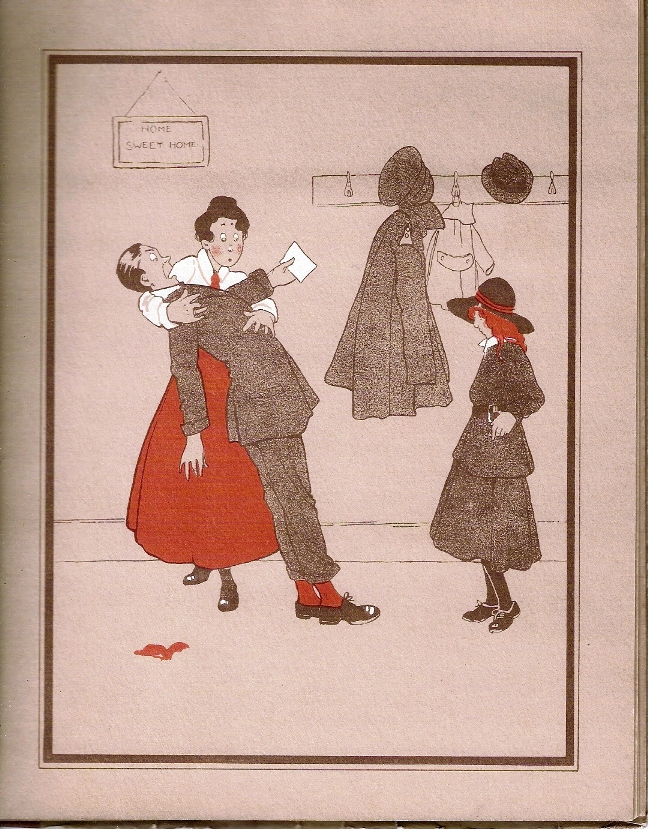
A cheeky boy it used to be
Who brought the wire telling me
That the horse I fancied most
Fainted at the starting post.
Now it is the Perky Pam
Who brings the fatal telegram
Thoughtfully instructing you
"Embark tonight for Timbuctoo"
***
Monday, 20 August 2012
Miss Loch and the Indian Nursing Service
The Indian Nursing Service was inaugurated in 1888 when two Superintendent Nurses and eight Sisters were sent to India, and worked alongside a complementary service formed by Lady Nora Roberts a year previously. By 1893 the number had risen to fifty-two, working at main Stations throughout India, with two or three Sisters at each, and sometimes working singly. Although their duties were intended to be of a supervisory nature, the lack of any dedicated corps of medical orderlies in India resulted in long and arduous working hours, assisted only by native servants, and a transient population of untrained regimental orderlies. Both the climate and the prevalence of disease caused the breakdown in health, and lifelong debility for many women who lived and worked in India during this period, but despite this, the Indian Nursing Service was popular, and never lacked applicants. Catharine Grace Loch was among the first group of nurses sent out in 1888, and she worked as Lady Superintendent until ill-health forced her retirement in 1902. Her edited notes and diaries make wonderful reading, both in outlining the military nursing service in India at that time, of which little detail remains elsewhere, and also for its outstanding description of the beauties and trials of life in India at the time. As the service increased in size, Miss Loch became increasingly concerned about both the type of woman being sent out, and also the obvious lack of good nurse training that was evident in many of those appointed by the India Office. Registers held at the British Library show that the India Office had a slightly unusual view on suitability, with social status and references from eminent and aristocratic 'names' being held in high regard, with nurse training coming in a poor second. Early in 1892, as the Indian nursing service grew, Miss Loch outlined her own concerns:

Feb.5 —I have been to Dr. Bradshaw's office to talk over with him a good deal of business and to arrange some matters which the Chief wants to alter. I then had to write a long official letter to Dr. B. which was to be forwarded to the Chief, stating my views on the subjects we had discussed; this was very difficult and took me a long time. I am desirous of trying to arrange some plan for selection of Sisters for appointment to the Nursing Service. I am not quite satisfied with some of the new ones nor was I last year, and I think they should not have been sent out. Dr. B. was much concerned when I told him this, and remarked that if nurses of the right stamp are not chosen the nursing scheme will not prove a success, and that is just what I feel too. Of course the gentlemen at the India Office know nothing about selecting or rejecting candidates; how should they ? I am awfully anxious that Mrs. Bedford Fenwick should be consulted in the matter as she is the best possible person. I do wish it would occur to Lord Cross as an excellent plan that I should come home for three months every year to choose nurses.
Feb.12.—I omitted in my last letter to refer to the question of training. The first official papers I saw stated twelve months' training as a necessary qualification for appointment. But in fact a Sister came out last year who had worked for barely six months and for that time solely as a paying ' pro.' in an obstetric ward. I remonstrated and wrote a letter to Government stating the importance, indeed the necessity, for a good three years' training. Whether in consequence of my letter I do not know, but soon afterwards the 'necessary qualification' was officially notified to be three years, instead of one. Nevertheless all the new Sisters appear not to have been thoroughly trained in general hospitals.
Mar.13 —Had to go to another station about a delinquent Sister, the case being one of complexity, and not without disgrace through serious indiscretion. The worst of it is that the culprit is a lady and a clever woman. As to selections of future nurses it would be a great comfort if something could be done. Though after all one can never be sure of anything, for people do behave out here so differently from what they do at home; they seem to be transformed into quite different persons, so even with the greatest care some of them may be found tiresome. Still I should trust Mrs. Bedford Fenwick's recommendation a great deal. But in any case it would be impossible to tell in a mere interview whether the candidate is suitable or otherwise. Appearances are absolutely deceiving, and manner alone is not a safe guide. Therefore it becomes all the more important that the nurses should come from hospitals where their general character has been well known. Doctors' testimonials are absolutely misleading, and often the most unsatisfactory women possess sheaves of the most flaring praise and admiration. I do not think there ought to be any difficulty in obtaining ladies in sufficient numbers. I am sure there would be none if things could be done quietly and gradually, but of course to find nineteen all at once is rather a large order; and when the appointments are made at such long intervals, naturally many who might have come out have settled down to something else before the next opportunity. I do think it will be a grave mistake not to send out ladies. First of all, it is hard on those who are not, because naturally they are sniffed at and make no friends; next, it is hard on those who are, because people always charitably judge the many by the few, and they will find themselves thrown out of their proper position in life on account of their colleagues. It should be borne in mind that the population of an Indian military station is always a shifting one; you cannot make a few friends and keep them as one would at home, it is an endless round of new acquaintances. Finally, if the Nursing Service were placed on a different footing, and a lower class of nurses avowedly introduced, I do not think it would answer at all. The orderlies would have no respect whatever for women whom they would consider of their own class, and the Sisters would perforce make friends with the apothecaries and sergeants and their wives and a whole new set of difficulties would arise which would put an end to the whole thing.
Loch, Catharine Grace, 1854-1904.
Catharine Grace Loch, Royal Red Cross, Senior lady superintendent Queen Alexandra's Military nursing service for India; Bradshaw, A. Fredrick, ed.; London, New York, H. Frowde.
Sunday, 12 August 2012
Voluntary Hospitals Database
At present I'm bent over a 1928 edition of the General Nursing Council Register of nurses, doing what can loosely be described as 'messing about' with lists and databases. As it runs to more than 2,000 pages, that's likely to be a lot of messing about. It lists all trained nurses who were registered with the GNC at that time as fit to practice, with details of their training hospitals and dates. Included are nurses who trained as early as the 1880s and also those who had just completed their training at the end of 1927, so there must have been many changes in hospitals during that period. Some of the hospitals are still household names today - places like Guy's, St. Thomas' and St. Bartholomew's Hospitals, London; Manchester Royal Infirmary, and Addenbrooke's Hospital, Cambridge. But as hospitals in general were much smaller at that time, it struck me that some of the many hundreds of hospitals mentioned in my register must have been very tiny indeed. Those that had just a couple of wards and a small medical and nursing staff probably accepted just one or two girls each year as new probationers, and the figures began to intrigue me.
While browsing the web for inspiration I came across the Voluntary Hospitals Database, which is a real treasure trove, beautifully and intricately researched and presented, which answers many of the questions about hospitals and their staff at various periods during the late 19th and early 20th centuries. It gives the number of beds, average bed occupancy, details of how many doctors, trained nurses and untrained probationers there were, and information about various aspects of expenditure. For some hospitals it's possible to track the increase in both patients and staff over many decades. I do realise that you probably need to be the sort of person who wears six anoraks at a time to appreciate its beauty, but well worth a look even for those who are just in T-shirt and shorts.
Voluntary Hospitals Database
If you just start to zoom on the interactive map and drag it to the area you need, a list appears in the left-hand margin giving details for each hospital in the current view - it's very clever and a great way to waste some time.
While browsing the web for inspiration I came across the Voluntary Hospitals Database, which is a real treasure trove, beautifully and intricately researched and presented, which answers many of the questions about hospitals and their staff at various periods during the late 19th and early 20th centuries. It gives the number of beds, average bed occupancy, details of how many doctors, trained nurses and untrained probationers there were, and information about various aspects of expenditure. For some hospitals it's possible to track the increase in both patients and staff over many decades. I do realise that you probably need to be the sort of person who wears six anoraks at a time to appreciate its beauty, but well worth a look even for those who are just in T-shirt and shorts.
Voluntary Hospitals Database
If you just start to zoom on the interactive map and drag it to the area you need, a list appears in the left-hand margin giving details for each hospital in the current view - it's very clever and a great way to waste some time.
Monday, 30 July 2012
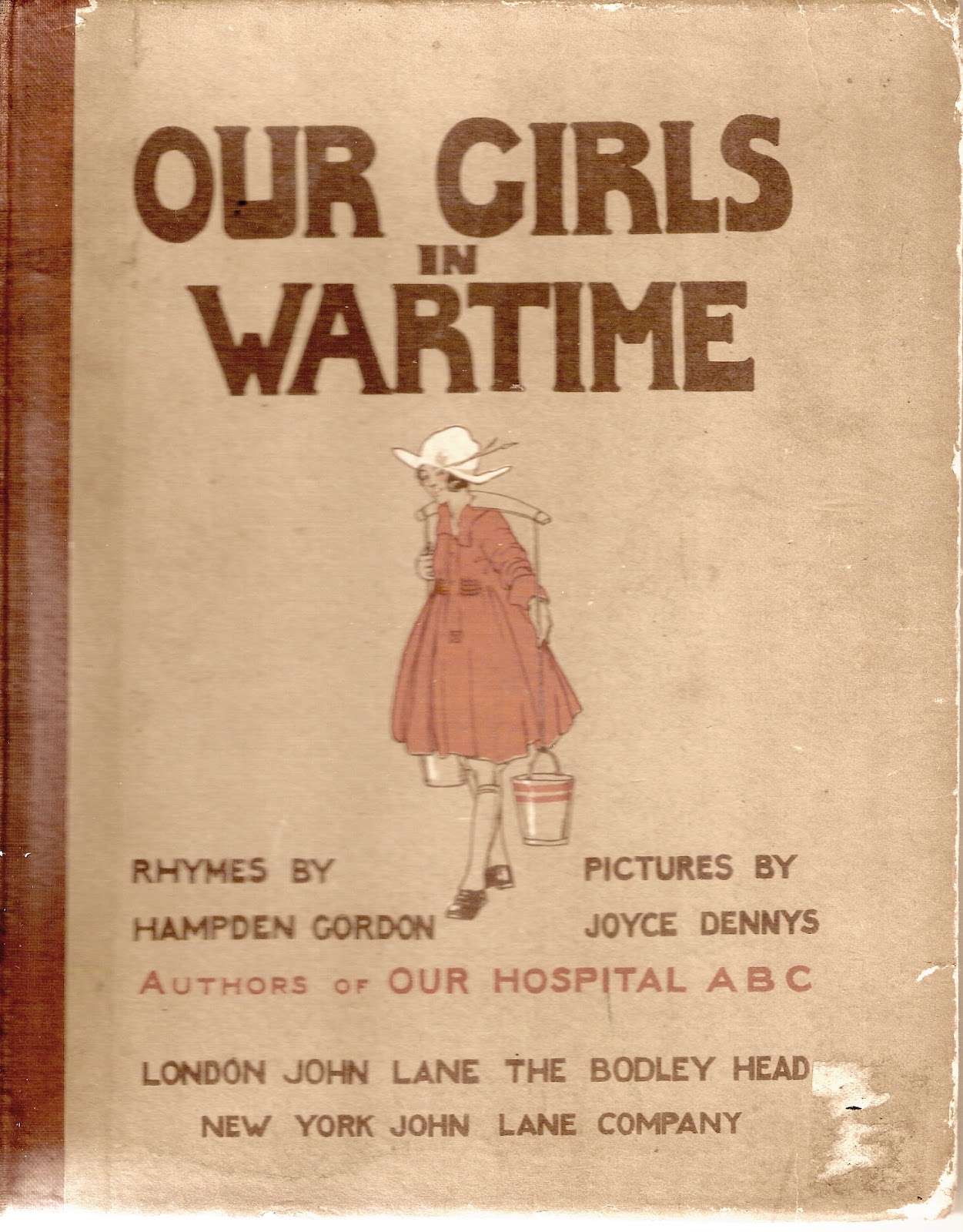
Our Girls in Wartime
Three years ago I added some images from 'Our Hospital ABC' here:
Our Hospital ABC
and was lucky enough recently to find a copy of its sister publication 'Our Girls in Wartime,' again with pictures by Joyce Dennys and rhymes by Hampden Gordon. So here are a couple of the pages with their rhymes:


Our Hospital ABC
and was lucky enough recently to find a copy of its sister publication 'Our Girls in Wartime,' again with pictures by Joyce Dennys and rhymes by Hampden Gordon. So here are a couple of the pages with their rhymes:
***

Martha, a Munition-maker
Manufactures shells
Martha's Father is a baker:
Cakes are what HE sells.
Martha swears the shells she makes
Do more damage than his cakes ...
Perhaps.
***

Miranda mixed with all the Nobs;
Her Depot made a million swabs
(War Hospital Supply).
'It was the good hard work,' she said
'That turned my hair this vivid red.
Never, my dears, say dye.'
***
Thursday, 19 July 2012
Queen Mary's Hostel for Nurses
QUEEN MARY’S HOSTEL
The Nursing Times, 1 March 1919
The work done by trained and untrained nurses in this war is a tale which is often told. A tale as yet untold is the fine work done for war nurses by Mrs. Kerr Lawson at Queen Mary’s Hostel for War Nurses, Bedford Place, London, one of the Hostels under the aegis of the British Red Cross Society. It falls to the lot of few women to have a grip – an unconscious grip – on the combined affection and admiration of hundreds of their fellow women. It points to some dominant quality which has so often belonged to some of our famous women leaders. The quality in Mrs. Kerr Lawson which holds other women was once expressed, more tersely and truly than she knew, by a Canadian sister: ‘That dear woman knows her job, and puts grit and love into it.’ The painful knowledge of the appalling burdens so many nurses are bravely and silently bearing came as a shock to Mrs. Kerr Lawson. The nurses with lightning intuition discovered that the right woman had been set down among them, and by degrees a never-ending stream of confidences relating to difficulties flowed to the superintendent in her restful study. Mrs. Kerr Lawson found herself not only Superintendent of a Hostel, but the confidante of nurses, and very often the lifter of their burdens. There is a great freemasonry in trouble. Those who have received comfort have not been slow to speak.
Queen Mary’s Hostel opened in Tavistock Place in the July of 1915 with free accommodation for twenty-three war nurses, irrespective of unit. The following July it was moved to Bedford Place with accommodation for thirty-five, though sometimes entertaining up to forty nurses. Two years later No.2 Hostel was opened at 52 Russell Square, for the Home Service Sisters of the British Red Cross, with twenty beds. In the February of 1918 a No.3 Hostel was opened at 50 Warwick Square for all members of the nursing services who required to spend one night only in London. The mother-hostel had not been open for long before it gained the reputation it now holds so firmly. News of it travelled to Gallipoli, Alexandria, Cairo, Port Said, and to Mesopotamia, as well as to the great centres of nursing on the Western front. When it is realised that all war nurses of the Empire are welcomed, irrespective of unit, the fascination of the contact with the women of far lands will be apparent. Those of us who have roughed it in home and foreign service appreciate to the full the home comforts in the hostels – the cosy bedrooms, the restful drawing-room, the well-cooked, daintily served meals – all the little thoughtful considerations following one’s kind welcome as an honoured guest.
Owing to the generosity of theatrical managers outside recreation has not been lacking. The mental refreshment this has meant to tired women can be but dimly realised. Our beloved Queen has taken a keen personal interest in the Hostel which bears her name, and has graciously sent gifts of flowers. On one of the occasions on which she visited the Hostel she addressed all the maids, and expressed her pleasure that they were working so happily and harmoniously in the common cause. Princess Mary is another Royal and welcome visitor.
‘How many of us have passed through this hostel?’ I once asked Mrs. Kerr Lawson.
‘About eight thousand.’
‘Then you have met a fairly representative crowd of us. What has struck you most about us, that is to say about the British nurses?’
‘The way in which some of you are putting up a fight against desperate odds, bravely and alone; the tragedy of those who have lost or are losing their precious health through war service, and who have others dependent on their earnings; the sad and bitter loneliness of those pushed through circumstances from their special home niche which, once having left, they never quite regain; and, above all, the scant means which so often renders them helpless when they should be independent.’ I knew this was cruelly true, and I thought of the spectre of Charity which is not always Love lurking for so many in days of misfortune behind the inadequate pay nurses receive for what is perhaps the most arduous but most devoted work in the world.
‘May you be given the strength to carry on; we sisters need women like you so sorely.’ A warm hand-clasp and I passed out, one more ship in the night, one which had received a God-speed from a very pleasant sport.
The time has come when this clash of arms is stilled, when nursing sisters need tend the sad results of war but little longer. They will then disperse in their thousands and go their world-wide ways once more. What memories they will have stored, of battle on the land and in the air, and of perilous journeying on the seas – of the super-human endurance of our fighting men! Midst memories sad and drear will come one tender one – of the understanding woman, with true and steadfast eyes and mother’s heart, who gave to them the richness of her sympathy and to many a despairing nurse the strength to bear her load.
A. M. CAMERON
Subscribe to:
Posts (Atom)

