Saturday, 25 May 2013

Amy Frances Turner

I included a photograph with my last post of Amy Frances Turner, so I thought it would be worth writing a little about her wartime service - a little bit is all I have of course. She was born in York in 1883/84, the daughter of a printer's compositor, and trained as a nurse at Northampton General Hospital between 1906 and 1909.

Amy Turner became a member of the Territorial Force Nursing Service shortly after the outbreak of war and in December 1914 she was sent to the No.3 Southern General Hospital (TF), Oxford, to work as a Staff Nurse.  I was sent a wonderful set of images taken at the hospital, by Judy Burge who lives in Australia and whose grandmother Isobel Wace also worked at the same hospital and was the owner of the photos - they give a remarkable and varied view of life at the hospital during the first half of the Great War. Amy was promoted to the rank of Nursing Sister on 13th July 1917, and in September,1918, she went to France to join the staff of No.54 General Hospital, Wimereux. In February,1919, she was invalided back to the UK for some surgery, and after her convalescence was demobilised on the 6th May,1919. Her next-of-kin is given throughout her file as her married sister, a Mrs. Cawley who lived at 21 Harlech Avenue, Leeds.

After the war, like many other nurses, Amy Turner remained a demobilised member of the Territorial Army Nursing Service, prepared to re-join in the event of further hostilities. But for her that time didn't come, as a letter in her service file shows that she resigned the service just after the outbreak of the Second World War on 12th September, 1939. Surprisingly, her reason was her forthcoming marriage and subsequent move to Canada. Unfortunately there is no note in her file giving her married name or a later address, but it does show that it's never too late to start a new life! The caption on the photo from Judy reads 'Don't know this lady but someone may.' Hopefully someone will.


Friday, 24 May 2013

Women and the Great War Centenary

Amy Frances Turner (courtesy of Judy Burge)

I feel that by the time we reach August next year I might be all centenaried-out.  Already there is so much publicity, advance announcements of planned TV programmes, authors rushing to make sure they make the deadline with their latest books, and various institutions nationwide preparing their own events to mark the date.  Although so much emphasis seems to have fallen on 1914, the centenary commemorations, like the war, will go on for four years, and the fall-out for much longer. By the time we get to 1919 the whole caboodle will, I expect, simply be taken over by the 90th anniversary of the Second World War.  One of the main initiatives is in the hands of the Imperial War Museum who are hoping to gather a database of those who served, with the help of the general public - Lives of the First World War. Do sign up to receive latest news about the project and find out how you can contribute.

However ... I already have some doubts about the way in which the contribution of women will be represented. After all, many women belonged to civilian organisations that were not under military control, or were formed to give aid to military personnel other than those from Britain and the Commonwealth. They include munitions workers; members of War Hospital Supply Depots who produced almost all the dressings and surgical requisites used by the B.E.F.; the majority of VADs who worked in hospitals under control of the Joint War Committee; members of the French Red Cross, the Scottish Women's Hospital, the Serbian Relief Fund, Queen Mary's Needlework Guild, the YMCA and YWCA, and so many more - the list is a very long one. Hundreds of thousands of British women played an active part in the Great War, often on the Home Front, but are certainly not counted among the '8 Million' participants suggested by the IWM.

The IWM have been keepers of a 'Women's Work Collection' since 1919 when Priscilla, Lady Norman and Agnes Conway first began to gather photos, information and evidence of the contribution of women to the war. They hold thousands of photographs of women who either died during their war service, or were honoured for the part they played.  At present I'm indexing, just for my own information and pleasure, a thousand photos of women who were awarded the DBE, CBE, OBE, MBE, or the Medal of the Order of the British Empire during, or shortly after, the Great War. The range is vast, from titled ladies - aristocrats out of the very top drawer - right down to the most humble of munitions and factory workers. In this last category many were 'rewarded' after having been blinded or disabled during the course of their work, which probably took the place of any formal pension or disability benefit.

Part of the IWM's project is now up and running - it's called 'Faces of the First World War' and they are adding a new photo each day and inviting further comment or information. As of today there are 457 photos to view. Of those, just a single one is of a woman, a munitions worker who died as the result of TNT poisoning. I know that this omission isn't because they're short of wonderful photos of inspirational women - they're not. I know it isn't because they have ignored women over decades - they haven't. So why such a reluctance to put women in their proper place in relation to the Great War? Maybe it's because the person or team entrusted with this task are, like many others, only interested in Infantry, Artillery, guns, tactics, strategy - men's things.

The gap needs to be filled - it can't be that difficult. But if this is an example of things to come, women of the Great War, our women, will be poorly served.

Jane Croasdell

Monday, 6 May 2013

Ambulance Trains - Crossing London

I grew up in the London suburbs, just a couple of hundred yards from a railway station. It was an odd sort of station as which ever way you went - there were only two platforms - you ended up at Waterloo half an hour later - that's where the train stopped. If you wanted to go north, east or west you then crossed London by tube or bus and reached one of the other London terminus stations - Paddington, Liverpool Street, Kings Cross ... that was where all the trains started from, and of course stopped. It never occurred to me that it was, or had ever been possible to cross London by train, without stopping.  London was one big full stop.By 1988 I was living near Brighton, and the Thameslink line opened.  I thought it was a great innovation, the ability to go right through the heart of London without changing trains, though I admit to never having gone beyond Farringdon. It never occurred to me that the wheel hadn't just been discovered, only re-invented.

So when I started to get interested in ambulance trains, it puzzled me how these huge trains, longer than anything we see now, could get from Dover, going north, without making some long haul round the M25 of railway lines. I apologise if this sounds really naive and stupid but I grew up spending my life on trains, and believe me, they always stopped at Waterloo or Victoria. Since then I've learned a little bit about the mass of independent railway companies that owned track nationwide, and the tangle of different lines that criss-crossed London taking trains anywhere at all if the mood took them.  So, to get to the point.

During the Great War there were three main ways that an ambulance train could cross London on its way from Dover, depending on its stopping places and final destination. Briefly, they were:


The West route:  From Clapham Junction over the Thames at Battersea Railway Bridge (at that time called Cremorne Bridge), and then via Addison Road Station, now Kensington Olympia, and up via Willesden Junction and onwards north or westbound.

The Central route:  From Loughborough Junction in the south, across Blackfriars Bridge and then up through Farringdon, King’s Cross, and Snow Hill Tunnel - the current First Capital Connect (Thameslink) route.

The East route:  Up via New Cross and Surrey Docks in the south, crossing under the river via the Thames Tunnel between Rotherhithe and Wapping, then up the eastern side of Liverpool Street Station. The Thames Tunnel has had a long and chequered history, but today is used as part of tfl's London Overground services.

The Thames Tunnel in its original condition

So London has never been a full stop for trains, and even today you can travel long-distance north to south across London on at least two of the routes used during the Great War. The wheel is very old, and still going strong.

1899


Sunday, 5 May 2013

Ambulance Trains - where did they actually go?


During the Great War many existing railway lines nationwide were taken over by the Government in an effort to make the best use of services for transport of goods, armaments, service personnel, civilian travellers and also for ambulance trains. The vast majority of casualties from abroad arrived in the United Kingdom at either Dover or Southampton and unless remaining in one of those two towns they were then transported onwards by train to all parts of the British mainland.

There were two hundred 'stopping stations' - railway stations that received  sick and wounded men and women for onward transfer to local hospitals by motor car or ambulance, and a list of these can be found in 'British Railways and the Great War.'*  In alphabetical order, and excluding Dover and Southampton themselves, they were:


Aberdeen; Addison Road (now Kensington Olympia); Aintree; Aldershot; Ampthill; Avonmouth; Axminster; Bangour; Basingstoke; Bath; Belmont; Bentley; Berrington; Berwick; Bexhill; Bickley; Birkenhead; Birmingham; Bletchley; Bournemouth; Boscombe; Bradford; Brentwood; Brighton; Bristol; Brockenhurst; Brocton; Bromley South; Brookwood; Bulford; Bury St. Edmunds

Cambridge; Cambuslang; Canterbury; Cardiff; Carlisle; Catford; Chatham; Chelmsford; Chelsea; Cheltenham; Chester; Chichester; Chislehurst; Christchurch; Clacton-on-Sea; Clandon; Clapham Junction; Colchester; Cosham; Court Sart; Coventry; Crewe; Cromer

Deal; Derby; Devizes; Devonport; Dewsbury; Dorchester; Dundee; Durham; Eastbourne; East Croydon; Eastleigh; Edmonton; Edinburgh; Egham; Epsom; Exeter; Farnborough; Faversham; Fawkham; Fovant Railhead; Fratton

Gillingham [Dorset]; Glasgow; Gloucester; Gosforth; Gosport; Grantham; Gravesend; Greenock; Greenwich; Guildford; Halesworth; Halifax; Hamworthy Junction; Harlow; Harrogate; Haywards Heath; Hereford; Herne Bay; High Barnet; Holmwood; Huddersfield

Ingham; Ingress Park Siding; Ipswich; Keighley; Kendal; Lancaster; Leeds; Leen Valley; Leicester; Leigh; Lichfield; Lincoln; Liphook; Liverpool; Lyme Regis; Lyminge; London Charing Cross; London Paddington; London Victoria; London Waterloo

Maidstone; Malmesbury; Manchester; Margate Sands; Mayfield; Minster Junction; Napsbury; Neath; Netley; New Barnet; Newbury Park; Newcastle-on-Tyne; Newcastle-under-Lyme; Newmarket; Newport; Newton Abbott; Northampton; Norwich Thorpe; Nottingham; Orpington; Oswestry; Oxford

Paignton; Paisley; Penrith; Perth; Plymouth; Poole; Portsmouth; Preston; Ramsgate; Reading; Rubery; Saffron Walden; Salisbury; Selly Oak; Sheffield; Sherbourne (sic); Shorncliffe; Shrewsbury; Sidcup; Sidmouth; Sittingbourne; Snaresbrook; Southall; Southend; Southport; Stafford; Stoke-on-Trent; Stourbridge; Stratford; Stratford-on-Avon; Strathpeffer; Sunderland

 Taplow; Templecombe; Tidworth; Tonbridge; Torquay; Torre; Walmer; Waltham Cross; Walton-on-Thames; Warminster; Warrington Arpley; Well Hall; West Croydon; West Gosforth; West Marina; Weymouth; Whalley; Whitchurch; Willesden; Wimborne; Winchester; Windemere; Windsor; Witley; Wrexham; York

Strathpeffer Station

The farthest north of these was Strathpeffer, a distance of approximately 625 miles away, and an estimated journey time (with a fair wind and bit of luck) of 20 hours and 33 minutes.  Thank goodness that Richard Beeching was only one year old when the Great War started and many years away from wielding his axe.

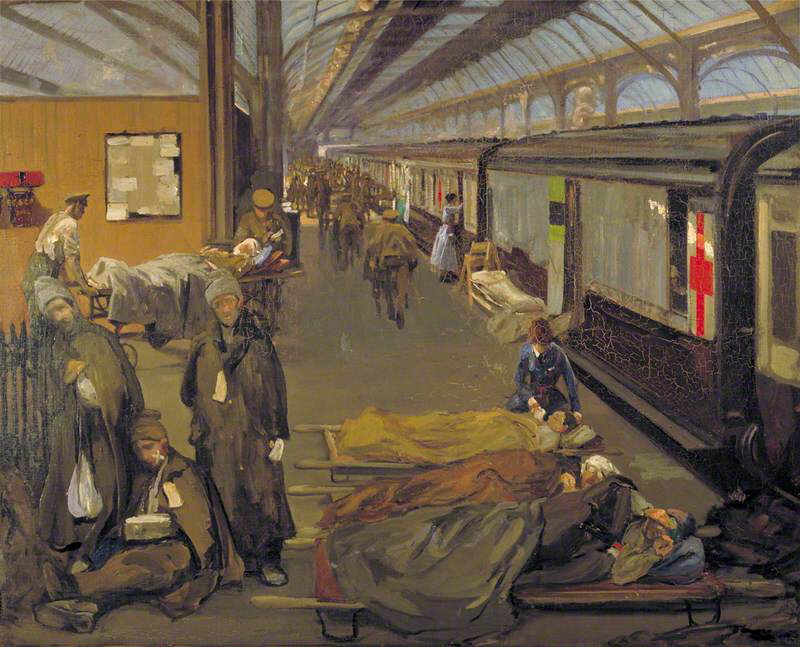
The Wounded at Dover by Sir John Lavery (Imperial War Museum)
***

*British Railways and the Great War, Edwin A. Pratt (Two volumes); Selwyn and Blount, 1921; now freely available online.

Sunday, 21 April 2013

Versailles - The British Hospital, 1914

Following the events of the Boer War where hundreds of wealthy female 'camp followers' invaded British hospitals in attempt to claim some involvement in nursing the sick and wounded, the War Office made every effort to ensure that in any future war strict controls would ensure that only authorised and approved workers were allowed to be employed in British hospitals. I've recently acquired a copy of a book written by Maud Sutton-Pickhard, who seems to have followed in the footsteps of her South African sisters in gaining admittance to places that she should not really have been.  Her sheer nerve and arrogance are a sign that life, particularly for the rich, was rather different a hundred years ago.  Having been refused a job by the American Ambulance in Neuilly on account of her lack of qualifications or experience, she wanders around Paris seeing the sights, and one morning took the train to Versailles 'to see the big English hospital there.' As there are so few accounts of the hospital I guess she should be thanked for writing about her experience.


At Versailles I had an omelette at the little station inn called the " Lion d'Or," and then I went to a tabac  and bought all the French cigarettes I could find as there were no English ones, and some tobacco and cigarette papers. (Horrid cigarettes they are too ! — but the "Tommies" seemed pleased to get them, as smoking is their one solace.)

Walking up the fine avenue called the Boulevard de la Reine, with its noble trees, I came to the magnificent hospital, formerly the Trianon Palace Hotel. It is a truly ideal spot for a hospital, and it is a marvel of English efficiency and organization. I was one living exclamation point of admiration from the moment I entered the gate until I left. The grounds were filled with convalescents in khaki, all looking happy and cheerful. I passed them and went to the front door, where a Red Cross soldier asked me very politely whom I wished to see. I had been asked the same question in the grounds. I said I wished to look over the hospital; so he called the Colonel. The latter was exceedingly courteous, but it was obvious that he was somewhat puzzled at my unexpected arrival. (I seemed to be the only visitor except one old French Sister with a basket of food.) He asked me if I knew any of the officers, if I knew anyone in the hospital. I said I was awfully sorry, but I didn't — that I had just heard about the hospital, and had come up to look it over and take some Kodak pictures.

He said, "You want to take Kodak pictures of the wounded?"
"Of the hospital and grounds — of the whole thing in fact," I replied.
"What do you want to do with the pictures?"
“Oh, send them to my friends to show what a nice place the wounded have over here."

He seemed satisfied, and said, “It is rather unusual, but you don't look like a German spy! "I laughed and got out my passports for him. He examined them, but he still seemed a trifle puzzled. Finally he said he would show me round, and he told me there was going to be a funeral that afternoon, and asked me if I wanted to go to it. We met the old French woman in the hall, and he asked if I knew what she wanted.
I said, "Why, don't you speak French?"
He said, "Not a word."

The interpreter had come forward, but I found out that she just wanted to give the things in her basket to the soldiers in the garden, only she wanted to distribute the stuff herself, and it was against the regulations. The Colonel looked in her basket, and told me to tell her that she could do so to those out of doors but not to those in the wards. Then he shook hands with her, and we wandered through the ground floor ward, while I distributed the cigarettes among the Tommies. The Colonel stopped to give some directions about a wounded man, so I said I would go on upstairs. He told me to knock at any door before I went in, but I preferred to get hold of a Sister, and she took me in to see an officer in the Worcestershire Regiment. I offered my own private cigarettes to the young man, who was evidently pleased to see visitors. The poor boy had been shot in both arms and one leg.  His right arm was paralyzed. But, in spite of this, he was most anxious to get well and return to the Front. I started to go, and he said, " Oh, don't go yet ! " I replied that I feared conversation would tire him, but he said that on the contrary it took his mind off himself. So I sat down on an adjoining bed while he told me the history of his battles and wounds. It was quite thrilling, yet so simply told, with only the barest necessary mention of himself — all about his men, and the Germans and the fighting. He had crossed a branch of the Aisne, by wading, in order to take a farmhouse on the opposite bank ; there he found he was trapped, with the Germans at his back, behind some trees. He had taken sixteen prisoners, but they had surrendered only in order to lead him into a deadlier place in which he was ambuscaded. There was no way out but to hurry back through the fire. He had been the first to cross, so he was the first to discover the trap, and hastily called to his men to get back as quickly as they could. Though wounded in both arms, he managed to get away, but was again hit in the leg at the last moment. He was helped out of danger by some of his men, but it was hours before he could see a doctor. He had to lie on straw and freeze until he could get medical assistance, and finally be moved to a hospital. He told me a lot about the Germans. They are very tricky, but the men only obey orders. One German prisoner told him that he did not know he had been fighting the English!

Fearing to fatigue him by letting him talk too much, I went upstairs and gave the Tommies on the top floor the rest of my cigarettes, helping them to light them, and trying to say some words of comfort. They seemed so pleased to have someone to talk to, and so grateful for the wretched cigarettes. Some had just arrived from the trenches, and they looked most horribly weak and ill. But all of them were so brave and patient and cheerful, although they brought tears to one's eyes when they said how glad they would be to see wife and children again.

I went over the grounds and inspected the tents, which are ideally clean and well arranged. The entire place struck me as the perfection of efficiency and comfort. Before I left I had an opportunity of seeing the funeral. It was a most imposing and solemn sight. When the hearses were drawn up in front of the gates everybody stood, the convalescents, who were sitting on chairs in the sunshine and under the lofty trees, rose and leant against their seats, or else they were helped up and supported by their comrades. There were six men buried, all English soldiers. Hundreds of French people crowded outside the gates, and the great majority of them followed the funeral to the cemetery as a tribute of respect to their brave Allies.

France in Wartime 1914-1915: Maud Sutton-Pickhard: Methuen & Co. Ltd., London, 1915
(and freely available on the web)

Sunday, 24 February 2013

Leaving France

Several years ago now I transcribed the official war diary of Maud McCarthy, Matron-in-Chief with the British Expeditionary Force in France and Flanders during the Great War. She arrived in France on the 15th August 1914, and except for a break after suffering a serious illness, she worked continuously and tirelessly until her final return on the 5th August 1919. She spent five years of non-stop work with barely a day off and only the briefest periods of leave, running the military nursing services with precision, inspecting hospitals and casualty clearing stations, and leaving her mark on everything and everybody she came into contact with.  She was not a young woman, fifty-five when the war started, but her energy and charisma were remarkable. I typed my way through Miss McCarthy's war - four thousand pages of it - and began to understand just a little of the difficulties she faced as the war grew and she struggled for staff, and order, and perfection - nothing less was good enough for the sick and injured. When I reached her final day in France I found it almost impossibly emotional. The account, written by her successor, Mildred Bond, paints the most vivid picture how much respect and love she commanded. While going through some photos I found a series of grainy snaps taken by a nurse that day.  They are of poor quality, indistinct, and faded, but along with Miss Bond's words, go some way to describing the feelings on the quayside at Boulogne on the 5th August, 1919.


05.08.19
Departure of Matron-in-Chief, France
On August 5th the Matron-in-Chief, BEF left France, from which date I took over the duties of Principal Matron of France and Flanders. On the evening of the fourth, Dame Maud McCarthy GBE, RRC, dined with the DMS General Gerrard CB, and the officers of his staff, who were giving a farewell dinner in her honour.  The following guest were present:  Colonel Barefoot DDMS, L of C, Colonel Statham the DDMS Boulogne and Etaples, Colonel Gordon the ADMS Calais, and also the A/Principal Matrons of the Areas, Miss L. E. Mackay QAIMNS, Miss Allen QAIMNS and Miss Rowe QAIMNS; also Miss Congleton QAIMNS, Matron 32 Stationary Hospital; Miss G. Wilton Smith and myself.  In the centre of the dinner table was placed a gorgeous basket of choice hot-house flowers which was afterwards presented to Dame Maud, and the DMS made a very appropriate and gratifying speech in which he expressed so much appreciation of her noble work and character and regrets at her leaving France, in which we all concurred so heartily.

On the afternoon of the 5th, Dame Maud left by the afternoon boat for England.  I went with the DMS in his car to see her off, and Miss G. Wilton Smith and Miss Barbier CHR went with her in her own car.  There was a large crowd waiting on the Quay when she arrived.  Among those present were a  Representative from GOC, General Asser being absent from Boulogne; the DMS and his staff; Brigadier General Wilberforce CB CMG the Base Commandant; Colonel Barefoot DDMS L of C; Colonel Statham DDMS Boulogne and Etaples; Colonel Gordon the ADMS Calais; and many other officers; Major Liouville, who represented the French Medical Service and Monsieur M. Rigaud, Secretary to the Sous-Prefecture who represented the French civil population, came in place of Monsieur M. Buloz who was absent from Boulogne.  These two men thanked her on behalf of the Military and Civil Authorities for all the goodness and courtesy they had always received at her hands.  The Matrons and the Nursing Staff from all the near Units who could be spared from duty and who were anxious to show a last mark of respect to their retiring chief were present.
She shook hands with everyone and was wonderful to the last, in the way she carried through a most difficult and trying farewell.  Her cabin was a perfect bower of most beautiful flowers sent from the staff of the different Hospitals.  One of her own staff, Miss Hill VAD, was able to cross with her as she was going home on demobilisation.  As the ship moved off the Matron-in-Chief, Miss Hill and Major Tate RAMC of the DMS staff, who was proceeding to England on transfer, escorted Dame Maud to the bridge and remained with her.  They all waved from the bridge and we all waved and cheered our loudest and sang “For she’s a jolly good fellow” as the ship sailed out of the harbour.  I think we shall never forget that sight and shall always like to remember the courageous and plucky way in which our chief carried our flag flying to the very last moment into her civilian life, where we wish her all happiness and success and where she will still command the love and respect of us all.


*****

The war diary is held at The National Archives, ref: WO95/3988-3991 and the transcription can be found here: Official War Diary of the Matron-in-Chief with the B.E.F. in France and Flanders


Monday, 11 February 2013

A New Year Message to the Boss

At present I'm going through nurses' service files and am finding all sorts of interesting items which escaped the violence of the 'weeding' process at the War Office in the 1930s.  One thing that stands out is the more compassionate tone (if that's the right word) of official correspondence in the Territorial Force Nursing Service files, when compared to similar items in QAIMNS files. The TFNS so often strikes a more personal, friendly note, and the senior members appear to have a closer and more genuine connection with their nursing staff.  And it went both ways as this letter shows, written by Helen Brotherton, while working as Matron of the Hospital Ship 'Newhaven,' to Miss Sidney Browne, Matron-in-Chief, Territorial Force Nursing Service.

*****
Dame Sidney Browne by Austin Spare IWM Art 2768


Hospital Ship Newhaven
Dieppe
January 1st, 1916

To: Miss Sidney Brown, Matron-in-Chief, T.F.N.S.

My dear Miss Sidney Brown

It is just a little over a year since you said goodbye to a party of us at Victoria Station, leaving for France.  I've been going to write to you often since then, I have often thought and spoken of you, and how splendid you are to us and how proud we Territorials are of ‘our Matron.’  I've had such a happy time since I came out and was attached to the Indian Expeditionary Force at the Rawal Pindi Hospital, then when the Matron of my section was moved to a large Camp Hospital, I went with her as Home Sister.  We had a staff of 90 Sisters and V.A.D.s.  I did so enjoy life under canvas and was sorry when the hospital had to disband as we were under water.  Then I had orders to join this Ship as Matron, it was good of Miss McCarthy to give me the post, she too has been awfully good to us.

I hope that you are well and that you will excuse the liberty I've taken in writing to you, but I thought it was so unkind of us to think all the good things about you and never let you know how grateful we are to you, for all the care and thought you've given our service.  I shall always be grateful to you for giving me the opportunity of nursing in France and helping our Boys, when they've done so much.  They are such splendid fellows.  We always go to Dover on the Home side and if ever you were there I should be so pleased to show you round my ship.

This War has few compensations, but one of them is that it’s given me an opportunity of serving my Country and you and Miss McCarthy.  My best wishes for the New Year.

I am, Yours most faithfully,
Helen Brotherton.

[TNA WO399/10029]