Showing posts with label Voluntary Aid Detachment. Show all posts

Monday, 25 April 2016

The Dead Nurses' Society


     The men and women who died on military service during the First World War are invariably  the group who attract the most publicity, most column space in newspapers and by far the most mentions on the web. Maybe that's understandable, not only because of the emotions that death during wartime arouses in people, but also because they are so much easier to research. Their names are on war memorials nationwide and the majority of those names are listed on the database of the Commonwealth War Graves Commission. With a couple of clicks it's possible to find relatives or local men and women who died while serving their country between 1914 and 1921. Their names truly 'Liveth for Evermore'.

     However, most of those who served their country didn't die but returned home again to take up employment, to marry and to prosper, or possibly to suffer from the effects of war throughout their lives, blighting their happiness. The majority of women were employed on the Home Front and although their work might have been demanding and stressful it rarely put them in immediate danger, though I must exclude munition workers here who often worked under dangerous conditions and who history has chosen to sideline more than any other group of women. The figures I'm using as examples are just a rough estimate but hopefully serve to make a point.

     Between 22,000 and 24,000 trained nurses served with Queen Alexandra's Imperial Military Nursing Service, it's Reserve and the Territorial Force Nursing Service. The lack of service records in the public domain makes an exact figure impossible to estimate. The number of untrained nurses - members of Voluntary Aid Detachments -  is even more difficult to work out. They included not only VADs who performed nursing duties but also General Service VADs who from 1917 worked as drivers, orderlies, waitresses, clerks, typists, and store-women in military hospitals. Then there were the members of War Hospital Supply Depots whose work involved the sewing of garments, the preparation of dressings and packing of stores and comforts for distribution both at home and abroad. Together the Red Cross workers are likely to have totalled well in excess of 100,000.  If you include nurses working in the military wards of civil hospitals the total figure for nursing staff engaged in caring for military personnel during wartime is likely to have totalled more than 150,000. In addition to these it's believed that nearly a million women were working in engineering and munitions.

     Of this multitude of women workers, only a tiny percentage died during wartime, less than 1% of the total - and of those, very few deaths actually resulted from war service. Most died due to illness or disease that would have proved fatal in any conditions, such as influenza, pneumonia, diabetes, gastric ulcers and cancers of many types. Dead women are now 'celebrated' on websites such as Facebook where many pages are dedicated to women who served during the First World War.  But far from remembering them all, these pages are frequently crammed with information solely on those who died and resulting in bland, throwaway comments such as 'RIP,' and of course, 'We will remember them.' No, I don't think you will - another couple of days and you'll have trouble remembering what you ate yesterday and certainly not the names or causes of death of women whose pictures you briefly looked at. Photos of headstones on Twitter may tell us a woman died, but say nothing about the work she did and what her life was like.

Victory Parade, London, July 1919.  They lived!  They lived!

     Why, why, why can't we celebrate what nurses DID during the war without this mawkish tendency to concentrate almost exclusively on the tiny percentage who died?  After all, they're all dead now, and  deserve the same respect and remembrance. Make nurses famous for their deeds, their endeavour and their dedication, not just famous for dying.


Monday, 21 December 2015

The VAD and the Casualty Clearing Station


     I'm always complaining about errors made in placing VADs in Casualty Clearing Stations during the First World War.  Writers of fiction, newspapers, the BBC, the world and his wife, all love to see them in the thick of it with bombs falling and shrapnel whizzing past the poor VAD on her way to the bin with an amputated leg.  It's fair to say that the senior medical staff in France and Flanders would have agreed to them being there, but the Matron-in-Chief was adamant that only the best and most experienced trained nurses were good enough to be working at the sharpest of ends and it was she who won that battle.  Of course if you look hard enough it's often possible to find an exception to any rule and during a long and varied war there was at least one VAD who managed to buck the trend.

     Alice Batt was born in Oxfordshire in 1890, the daughter of Charles Dorrington Batt, a doctor, and his wife Isabel (née Wake). By the outbreak of war Charles Batt and several of his children were involved with local Voluntary Aid Detachments, his son John, also a doctor, becoming resident medical officer during wartime at the large auxiliary hospital at Ampton Hall, Bury St. Edmunds. Alice Batt first worked as a VAD in London at the Officers' Hospital, 6 Bruton Street - the heart of Mayfair and in March 1916 she signed for overseas service and was sent to No.9 British Red Cross Hospital, the 'Duchess of Sutherland's,' at that time in Calais.

Operating theatre staff No.9 BRCS Hospital (Duchess of Sutherland's) in July 1917  [IWM Q2615]

     During the final weeks of the war as the British army advanced, the hospital moved further forward to Hazebrouck by which time Alice Batt was working as an operating theatre orderly. Although this was not a role undertaken by VADs in British military hospitals, it was found acceptable in units run under the control of the Joint War Committee of the BRCS and Order of St. John. By the beginning of October 1918 although Britain seemed to be winning the war, casualties were great and all medical units were working under extreme pressure.

     Three Casualty Clearing Stations working side by side at Rousbrugge [Roesbrugge], Nos.11, 36 and 44, were in danger of being overwhelmed with casualties and a request had been made for extra staff which could not be fulfilled at the time by other British units under War Office control.  The principal need was for 'surgical teams' which were mobile groups used to fill urgent gaps, and each team  was made up of one surgeon, one anaesthetist, a trained theatre sister and one or two theatre orderlies.  Appeals were made both to Canadian and American units who were able to send some reinforcements but the three CCSs at Rousbrugge were still understaffed.  At that point two surgical teams were offered by No.9 British Red Cross Hospital, an offer which was gratefully accepted and probably the only time during the war that this happened.  Theatre orderly Alice Batt was part of one of those teams and she joined the staff of No.36 Casualty Clearing Station. Within a few days she was at the centre of a drama for which she was later awarded the Albert Medal for her actions. The citation published in the London Gazette 25th April 1919, gives the details:

The KING has been pleased to award the Albert Medal in recognition of gallantry displayed in saving life: —
Miss -Alice Batt, Voluntary Aid Detachment
On the 1st October, 1918, a fire broke out at No. 36, Casualty Clearing Station at Rousbrugge, Belgium, and quickly reached the operating theatre, where the surgeon, was performing an abdominal operation. The light went out, and the theatre was quickly filled with-smoke and flames, but the operation was continued by the light of an electric torch, Miss Batt continuing her work of handing instruments and threading needles with steadfast calmness, thereby enabling the surgeon to complete the operation. Miss Batt afterwards did splendid work in helping to carry men from the burning wards to places of safety.

     As the staff of the Duchess of Sutherland's Hospital were predominately female, it's possible that Alice Batt was not the only VAD employed at a British CCSs during that hectic period, but the award of her Albert Medal makes her the only one to be positively identified.  Full details of Alice Batt's wartime service are included on the BRCS website here:

Original card that shows work in London

Later card for overseas service


*****


Friday, 22 August 2014

The VAD - For Better or for Worse


VADs at Royal Naval Hospital, Chatham [IWM Q18925]
 

     The centenary of the start of the Great War has brought with it many projects associated with hospitals active throughout the United Kingdom at that time providing care for sick and wounded soldiers. Almost all of these centre on the small auxiliary hospitals which were opened and run under the auspices of the Joint War Committee of the British Red Cross Society and Order of St. John.  In the main these hospitals were staffed by members of Voluntary Aid Detachments (VADs) the majority untrained or partly trained nursing assistants who had little pre-war experience of having to work outside the home and a minimal, if any, background in nursing.  They were supported by other volunteers who helped with housekeeping duties and by male orderlies who provided ambulance and other transport services and night staff for the hospitals.

     The VAD has become the Florence Nightingale of the Great War; all things to all men, beautiful, caring, patriotic and devoted to the cause of healing. I'm trying to think whether I've ever seen mention of one who was plain, unintelligent, lacking in common sense, rude, disrespectful or just plain hopeless.  Actually I have, mainly in reports on their work and behaviour by trained military nurses, but to cast a slur on this icon of womanhood might not go down too well ... well, just one little mention maybe ...  In a report on a VAD from the Matron of No.1 Southern General Hospital, Birmingham, under 'Nursing Capabilities' is written:

Have seen no evidence of any.  She is lazy, very noisy, and has very little idea of discipline.  Talks a great deal. 

     Needless to say, her contract was not renewed. But this type of comment is not uncommon among the VAD service files which still survive at The National Archives. My point is that it's neither accurate nor productive to constantly paint VADs as perfect women. They were not. They were young women from a variety of backgrounds and life experience and with very differing personalities. Most had no nursing experience, nor would they have ever considered nurse training in peacetime.  Only a very tiny number went on to train as nurses after the war, with those that had to earn a living finding employment they considered more suitable to their social station, such as medicine, teaching, public health and social work, and infant welfare. Marriage became by far the most popular post-war occupation.

     The VAD was essential to the running of the nursing services during wartime; she had her place; she did her best though it must be faced that in some instances that was not quite good enough.  She was not the universal panacea that cured all men and all ills. She simply played her part alongside the tens of thousands of experienced doctors and fully-trained nurses, the administrative staff, the clerks and secretaries, male ambulance workers, orderlies and many more. Maybe during the next four years she deserves a little bit less of the limelight and should move over a pace or two to let some of the others stand in the spotlight.

Thursday, 12 June 2014

The Very Last Page

     More than seven years ago I transcribed the official war diary of the Matron-in-Chief in France and Flanders, which covers the years from 1914 to 1920 and is held at The National Archives under the references WO95/3988, 3989, 3990 and 3991. It comprises around 3,400 pages, and fills, to the top, four archive boxes. The first entry is written by Maud McCarthy on Wednesday, 12th August 1914, the day she reported to No.2 General Hospital at Aldershot, to prepare for embarkation for France, and the last on March 31st 1920. Dame Maud wrote each page herself, in longhand, from the first day until the 31st August 1916. From 1st September 1916, the diary was typed by her office staff from her notes, either written or dictated, and other than short leave, and a period of absence between March and August 1917, when she underwent two operations for appendicitis, the diary was ‘hers’ until the day before she finally returned to England on August 5th, 1919.

     From that date until March 1920 the diary continued in the same form, written by her replacement, Principal Matron Mildred Bond, and reported on the hundreds of demobilisations of nurses, the slow run-down of hospitals and casualty clearing stations in France and Flanders, and the rise of medical units serving the British Army of the Rhine. A transcription of the diary up to March 1919 has been on my website Scarletfinders for the past six years. However, at that time I stepped back from transcribing the final year as in the main it's a catalogue of nurses' names and details of demobilisations and lacks the interest of the wartime years.

     Eventually I felt it might be useful, both to family history researchers and also to anyone who might, in the future, feel the need to research the nursing services in the immediate post-war period. So the final year is now complete, and although it won't go on the website, I'll happily send a copy to anyone who feels the need to read it - somehow I sense there won't be a rush, but do feel it's a good job finally done and dusted.

The National Archives WO95/3991 - The Final Page!

Thursday, 15 May 2014

After the Crimson Field

7 General Hospital, Malassises, Imperial War Museum


     According to the Economist there have been more than 25,000 books and scholarly articles written about the United Kingdom's part in  the Great War since 1918. I can't vouch for the figure, but it seems perfectly plausible to me. Most relate to the soldiers' story, to strategy and tactics, to organisation and administration and every detail of life in various armies during the conflict. If you need to know how a soldier enlisted, what he was paid, how he was transported, fed, equipped; how he washed and relaxed and 'went over the top' there's plenty of choice on where to find the answer, in official records, books, film, TV and increasingly on the web. If official accounts become a bit dry they can be supplemented by thousands of surviving first-hand accounts and memoirs. There must currently be hundreds of historians and researchers of the Great War who would have no difficulty at all in instantly giving chapter and verse on all aspects of a soldiers' life.

     This is far from the situation in relation to any area of women's service. A relatively tiny number of books have been published on nursing during the Great War and the majority of those are personal accounts in which the facts cannot always be verified or substantiated. In recent years female academics have tried to close the gap a little but however well-researched, the results are often unappealing to the general public and inaccessible due to the high cover prices set for the academic market. These books also appear to turn their back entirely on giving the same grass-roots information about the fine detail of nurses' service which can be so easily found in similar books relating men within a military setting. The result is that to the question 'Can you recommend a good book about nurses' the answer will invariably settle first around Lyn Macdonald's 'Roses of No Man's Land,' Vera Brittain's 'Testament of Youth' and occasionally something else that probably doesn't even relate to a British nurse's experience of war. It seems almost impossible to find the answer to same questions of organisation and administration relating to women's service that are so clearly defined for men.

     The fine detail of military nurses' service during the Great War is largely lost - it's a yawning gap waiting to be filled. In some respects you could fill it with anything and few people would be any the wiser. There would be few opponents to a statement that nurses earned £20 a year, or £50 a year or £200 a year because it's information that's hidden and difficult to find. There would be few opponents to comments that Great War nurses could marry, or maybe couldn't marry, or if they could marry they had to leave - or perhaps they were allowed to stay? And did VADs actually spend their time outside washing bandages or collecting sticks in the woods? Who is there who knows? So when the BBC decided to commission 'The Crimson Field' they had a gap to fill and unfortunately it was a gap that to the viewing public was an 'unknown.' They had the freedom to fill it with whatever they felt was suitable regardless of whether it was historically correct. And by 'historically correct' I don't mean the tiny things like fine details of uniform and kit, but the basic knowledge of what life was like for nurses and doctors and how hospitals worked in France at that time. What's missing from the programme is any deeper understanding of the nurses and hospitals - their foundations are missing and experience and integrity have been removed.

     To those who say 'it's only drama' I'd reply that it's historical drama and has been heralded by the BBC as an important part of their Great War Centenary programming. Because of that it has a duty to be as historically accurate as possible. To those who say that it's no different to believing that 'Holby City' is an accurate portrayal or that crime drama fails to reflect modern policing, I insist that there is an enormous difference. Hospital life and police procedure today are part of our current knowledge. If we watch modern hospital drama we have experience to judge it by, either our own or that of our friends and family. We can dismiss what is unbelievable because we have the personal knowledge of what it's really like. In 'The Crimson Field' the BBC have produced a programme that has filled an existing gap in history that is outside people's experience and they have filled that gap with stories that could not and would not have happened.

     Because of the high regard in which the BBC is held, the programme has made itself historically correct and has set a model for the future. It has given a representation of nurses, doctors and hospitals that will now be followed, honoured and repeated for decades. Mention of the programme is already being used to give credence to many serious centenary projects and books in order to boost visitors or sales regardless of whether it has any relevance or validity.  In my opinion it has set the serious research of nursing in the Great War back to a point where there may be no hope of ever resurrecting it - why bother in the future when it can be wiped out at a stroke and with such ease?

Thursday, 10 April 2014

The 'Volunteer Nurse'


     With the screening of 'The Crimson Field' on TV, there seems to have arisen some confusion over the 'Volunteer Nurse.' This morning I came across a newly-published edition of Olive Dent's book 'A VAD in France,' first published in 1917 by Grant Richards, and for some years available in new editions or as a free download from the web.**   I was rather shocked that not only is it being promoted as some sort of spin-off from 'The Crimson Field' complete with a cover illustration strongly suggestive that its contents are related, but that the original title has been changed to suit the publisher. It seems an incredibly arrogant stance for a publisher to take, and I have to wonder whether they think the change in title will fool the unwary into believing that it's a different book to the one that can be found free elsewhere. At the very least it shows dishonesty and a complete lack of integrity.

A Volunteer Nurse on the Western Front

     But back to the 'Volunteer.'  When women joined a Voluntary Aid Detachment in the United Kingdom, they received no pay, but were provided with board and lodging if working away from home. When they went overseas, the majority found themselves in a very different position. VADs who worked overseas in British hospitals under War Office control were paid. They received a basic salary of £20 a year, with extra allowances which were extremely generous, and in total added up to more than £115 a year in payment or in kind. It put their annual salary on a par with, or above, many women workers in the UK. To imply that they were working as 'angels and heroines' for nothing is entirely wrong. In the recently published 'Dorothea's War,' the wartime diary of VAD Dorothea Crewdson,* she was constantly surprised at the size of her monthly pay-packet. On the 4th August 1915 she wrote in her diary:

Pay night and we have all received a monstrously and wonderfully large sum of money … The Sisters of course have different pay and more of it. We all feel robbers of the Matron as our salary for the month comes to more than £10 and we only expected £20 a year.

On September 21st she continues:

All the night staff were paid yesterday morning after breakfast.  Matron dispensed coins, done up and packed as usual. VADs got fr 302.75 which is more than £10. Pay is a wonderful mystery and seems always more than one ever expected.

And even when allowances for heating and lighting were discontinued the following year, she had no complaints:

Pay night yesterday and we got fr 334.90, the last big pay we shall have before allowances are cut down. But I am glad as I think it is a waste of English money to pay us all so much.

     So whenever you see VADs overseas patted on the head for doing their job for free, please bear in mind that they did not. They were paid appropriately for their work and they well understood the value of their pay.

*Dorothea's War: Edited by Richard Crewdson, Weidenfeld & Nicolson, 2013
** If you'd rather not pay for your e-book, Olive Dent's original text of 'A VAD in France' is available free:
A VAD in France

Sunday, 1 December 2013

An Unlucky Hospital

While one or two high-profile nurse casualties of the Great War are well documented, others who died or suffered injuries are rarely, if ever, mentioned. 
No.58 (Scottish) General Hospital arrived in France in the early summer of 1917. It was set up on open land on the outskirts of St. Omer and its early days seemed to be beset by difficulties. Due to a great shortage of hospital beds in France it was pushed into accepting patients before it had either adequate staff or facilities, but within a few weeks it was operating at near full capacity and by August things seemed to be going smoothly.

However, from the first days of September the town of St. Omer became the target for night-time aerial bombing by German planes, and No.58 General Hospital was busy taking in and caring for both military and French civilian casualties, many of whom died. As the situation became worse, arrangements were made for caves in the nearby public gardens to be taken over as air-raid shelters for staff of the hospital and also for any patients able to make their own way there on foot. At the same time, specially reinforced huts were erected where essential nursing staff could sleep safely. On the night of the 30th September, 1917, the worst fears became reality when the hospital received direct hits from German bombs. The account in the unit war diary (TNA WO95/4088) gives the details:

*****

1 October 1917
During a hostile air-raid on the night of 30/9/17-1/10/17 three bombs were dropped in the Camp at 10.40 p.m., (two on marquees for patients and one in the Nurses' Compound). Of the two bombs which dropped on the marquees one struck a marquee which was, fortunately, unoccupied. The other struck a Marquee occupied by patients and two nurses, who were on duty. The bomb which fell in the Nurses' Compound struck a Bell Tent, which was unoccupied as the two Nurses who sleep in the Tent were on Night Duty. The casualties which have resulted are:-
Nurses, killed three, wounded three (one dangerous).
Other ranks, killed 16, wounded 60.
Total killed 19, wounded 63.

Of the other ranks wounded 14 were transferred to other hospitals and one of these has since died. There has been much damage to canvas and equipment. 54 marquees (Hospital, large) have been damaged, more or less. Two have been absolutely demolished while the damage to the others varies from almost complete destruction to mere riddling. 21 Bell tents have been damaged, one was completely destroyed by a bomb and 20 have been riddled. Many pieces of iron pierced the new corrugated iron sleeping hut for Sisters. One piece pierced iron and three pieces of asbestos boarding. Numerous panes of glass have been broken in the permanent buildings. One of the Ablution Houses has been damaged.

SURGEON GENERAL MACPHERSON, the A.D.M.S., and the MATRON-IN-CHIEF called today and it was arranged for the transfer of all lying cases to other hospitals so that at night the walking cases left in hospital might go to the Cave in the Public Gardens and sleep there. It was also arranged that all the nurses should sleep in other hospitals. In the evening patients and Unit moved to the Cave in the Public Garden and only Police and a few orderlies were left in the Camp. The three wounded nurses were transferred today to No.10 Stationary Hospital.

2 October 1917
The three nurses (Sister Climie, Nurse Thomson and Nurse Coles) and the 16 other ranks killed by hostile aircraft on the night of 30/9/17 and 1/10/17 were buried at 4 p.m. today in the Souvenir Cemetery, Longuenesse. Sister Milne who was dangerously injured in the same air-raid died last night in No.10 Stationary Hospital. Two other ranks who were wounded have died today so that the statistics as a result of the raid are to date:
Dead: Nurses 4, Other Ranks, 18.
Wounded: Nurses 2, Other ranks, 58
Total: Dead 22, Wounded 60.

*****

The graves of Daisy Coles and Mabel Milne at Longuenesse (St. Omer) Souvenir Cemetery


The nursing staff who died as a result of that raid were all either members of, or attached to, the Territorial Force Nursing Service:

Staff Nurse Agnes CLIMIE
Staff Nurse Mabel MILNE
VAD Daisy COLES
VAD Elizabeth THOMSON

and the two wounded nurses:
Staff Nurse Christina. A. DAVIDSON
Staff Nurse Florence McKELLAR

Wednesday, 12 June 2013

Dorothea's War


Dorothea Crewdson was one of more than 100,000 women who served as VADs during the Great War, but in so many ways she stands above the heads of others.  She was one of only a small number of women to receive the Military Medal for her actions during an enemy air raid in 1918* and she is one of the few nurses to be commemorated by the Commonwealth War Graves Commission, dying during her period of active service in France.  More importantly she is one of that rare breed of nurses who left behind a diary that has survived through the decades.  There are a number of published personal accounts of VAD life during the Great War, most vague about names and places, frequently a mix of fact and fiction making it difficult to judge where truth ends and over-egging the pudding starts. Diaries can provide so much more, usually written with no other motive than to keep an accurate and honest record of a period of life and work which may prove useful at a future time.  As a private account there is no worry about naming friends and colleagues, and no fear of falling foul of the censor by mentioning individual hospitals and locations.

This diary, sympathetically edited by the author’s nephew Richard Crewdson, and accompanied throughout by Dorothea’s own original drawings, covers the entire period of her wartime service as a VAD in France between June 1915 and March 1919. It charts her time at three separate military hospitals and describes VAD life in great detail introducing many friend, relatives, patients and colleagues, some who were with her throughout the period. Very little is written elsewhere about the basic facts of a nurse’s life in France, and in this diary there’s a lot to be learnt about living arrangements, conditions of service, pay, ward work and above all about loyalty and friendship. Although sickness and death have a part in the book, they are not the main players.

The introduction to the book makes no secret of the fact that Dorothea Crewdson’s life was cut short, with her sudden death in France in March 1919.  That knowledge had a great impact on me. As the reader I was aware that I knew that which she did not – that her life was not going to be a long one; that this time next year ...  this time next month ... this time next week ...  I could hardly bear to turn the last few pages and enter her final days, the days that I knew about, but she did not.  The book ends with a letter written to Dorothea’s mother by her Matron, Melina McCord. It’s a heart-breaking tribute, guaranteed to bring tears to the eyes of all but the most dispassionate reader.

This diary informs and instructs, but more than that it shows that where loss, death and hardship exist, whether they be personal or professional, ways can always be found to deal with them. It makes essential reading for anyone with an interest in nursing, VADs and hospital life during the Great War.  But be warned – have a handkerchief ready for the finale.

* London Gazette, 30 July 1918: For gallantry and devotion to duty during an enemy air raid. Although herself wounded, this lady remained at duty and assisted in dressing the wounds of patients.  DIED 12 March 1919

For a preview of the book, and a glimpse of some of the Dorothea's wonderful drawings, this will whet your appetite:

Dorothea's War - YouTube


*****

Dorothea's War, Dorothea Crewdson: edited by Richard Crewdson; published by Weidenfeld & Nicolson, 13th June 2013:  ISBN 978 0 297 86918 4
[Hardback and on Kindle]

Sunday, 24 February 2013

Leaving France

Several years ago now I transcribed the official war diary of Maud McCarthy, Matron-in-Chief with the British Expeditionary Force in France and Flanders during the Great War. She arrived in France on the 15th August 1914, and except for a break after suffering a serious illness, she worked continuously and tirelessly until her final return on the 5th August 1919. She spent five years of non-stop work with barely a day off and only the briefest periods of leave, running the military nursing services with precision, inspecting hospitals and casualty clearing stations, and leaving her mark on everything and everybody she came into contact with.  She was not a young woman, fifty-five when the war started, but her energy and charisma were remarkable. I typed my way through Miss McCarthy's war - four thousand pages of it - and began to understand just a little of the difficulties she faced as the war grew and she struggled for staff, and order, and perfection - nothing less was good enough for the sick and injured. When I reached her final day in France I found it almost impossibly emotional. The account, written by her successor, Mildred Bond, paints the most vivid picture how much respect and love she commanded. While going through some photos I found a series of grainy snaps taken by a nurse that day.  They are of poor quality, indistinct, and faded, but along with Miss Bond's words, go some way to describing the feelings on the quayside at Boulogne on the 5th August, 1919.


05.08.19
Departure of Matron-in-Chief, France
On August 5th the Matron-in-Chief, BEF left France, from which date I took over the duties of Principal Matron of France and Flanders. On the evening of the fourth, Dame Maud McCarthy GBE, RRC, dined with the DMS General Gerrard CB, and the officers of his staff, who were giving a farewell dinner in her honour.  The following guest were present:  Colonel Barefoot DDMS, L of C, Colonel Statham the DDMS Boulogne and Etaples, Colonel Gordon the ADMS Calais, and also the A/Principal Matrons of the Areas, Miss L. E. Mackay QAIMNS, Miss Allen QAIMNS and Miss Rowe QAIMNS; also Miss Congleton QAIMNS, Matron 32 Stationary Hospital; Miss G. Wilton Smith and myself.  In the centre of the dinner table was placed a gorgeous basket of choice hot-house flowers which was afterwards presented to Dame Maud, and the DMS made a very appropriate and gratifying speech in which he expressed so much appreciation of her noble work and character and regrets at her leaving France, in which we all concurred so heartily.

On the afternoon of the 5th, Dame Maud left by the afternoon boat for England.  I went with the DMS in his car to see her off, and Miss G. Wilton Smith and Miss Barbier CHR went with her in her own car.  There was a large crowd waiting on the Quay when she arrived.  Among those present were a  Representative from GOC, General Asser being absent from Boulogne; the DMS and his staff; Brigadier General Wilberforce CB CMG the Base Commandant; Colonel Barefoot DDMS L of C; Colonel Statham DDMS Boulogne and Etaples; Colonel Gordon the ADMS Calais; and many other officers; Major Liouville, who represented the French Medical Service and Monsieur M. Rigaud, Secretary to the Sous-Prefecture who represented the French civil population, came in place of Monsieur M. Buloz who was absent from Boulogne.  These two men thanked her on behalf of the Military and Civil Authorities for all the goodness and courtesy they had always received at her hands.  The Matrons and the Nursing Staff from all the near Units who could be spared from duty and who were anxious to show a last mark of respect to their retiring chief were present.
She shook hands with everyone and was wonderful to the last, in the way she carried through a most difficult and trying farewell.  Her cabin was a perfect bower of most beautiful flowers sent from the staff of the different Hospitals.  One of her own staff, Miss Hill VAD, was able to cross with her as she was going home on demobilisation.  As the ship moved off the Matron-in-Chief, Miss Hill and Major Tate RAMC of the DMS staff, who was proceeding to England on transfer, escorted Dame Maud to the bridge and remained with her.  They all waved from the bridge and we all waved and cheered our loudest and sang “For she’s a jolly good fellow” as the ship sailed out of the harbour.  I think we shall never forget that sight and shall always like to remember the courageous and plucky way in which our chief carried our flag flying to the very last moment into her civilian life, where we wish her all happiness and success and where she will still command the love and respect of us all.


*****

The war diary is held at The National Archives, ref: WO95/3988-3991 and the transcription can be found here: Official War Diary of the Matron-in-Chief with the B.E.F. in France and Flanders


Thursday, 31 January 2013

Dead Man's Land - Robert Ryan


I'm a great reader of crime fiction, often to the exclusion of doing other, more important things.  On the whole I stick to British authors, like complex plots, skip over too much gratuitous violence, and prefer to arrive at the end actually understanding what's gone on in the middle. So about eighteen months ago I was intrigued and rather flattered to be asked by Robert Ryan if we could meet up to discuss a new book he was working on (these days a bit of flattery is so very welcome).  He intended to include 'some plucky VADs' and wanted to make sure that they would be appearing all present and correct.

Over the next months I was kept up to date with the progress of the book and then asked to check the first draft to see how the VADs were doing.  Anyone who has read this blog on a regular basis will know that of all the bees that float around my bonnet, the indiscriminate placement of VADs in Casualty Clearing Stations on the Western Front is the one that stings hardest, and in this book their inclusion in very forward areas was going to be essential to the plot. If I have learned one lesson from the exercise, it’s this.  If you’re a writer of fiction and make fundamental errors because of inadequate research and blissful ignorance, the wrath of pedants will be unleashed upon you.  On the other hand, if you include factual inaccuracies and weave them in an intelligent way, in full knowledge of your sins, you will always be forgiven (fingers crossed).

Dead Man’s Land was published at the beginning of this month with the full approval of the Conan Doyle estate. It follows Dr. John Watson’s travels around the Western Front during the Great War, and where Dr. Watson goes, death and intrigue are right on his heels. By most estimations he must be getting on a bit in age, but his physical limitations are highlighted, not glossed over, and his place as an elderly medical practitioner in wartime never seems extraordinary. The military setting is sound, and the depiction of hospitals and casualty clearing stations in wartime is thorough. The VADs are skilfully introduced into a place where they would never actually have been, with the difficulties and regulations surrounding their employment made clear. Even I was heard to clap. The story is unusual and absorbing, it has complexity, but with enough clarity to prevent it becoming confusing, especially for those who don’t usually dabble in ‘war,’ and it should appeal to everyone who enjoys crime fiction of any era, but perhaps especially to devotees of Sherlock Holmes.  Yes, of course he’s there as well.

And my thanks to Rob for his kind words in the acknowledgements where he accepts all errors as his own.  May I take this opportunity to clear my conscience and admit that there might just be one that’s mine!


Wednesday, 30 January 2013

If you think you're cold ...

... Just spare a thought for nurses in France during the winter of 1915.  Olive Dent worked as a VAD at No.9 General Hospital, on the race-course at Rouen, and her descriptions life 'on active service' are vivid, with lots of insights into living and working conditions that can't be found elsewhere. The book, no longer in copyright, if freely available for download from the web. Illustrations by R.M. Savage 'and others.'

*****


ACTIVE SERVICE IN THE SNOW

SNOW has fallen persistently for a fortnight. Its coming was presaged by leaden skies and dull grey shadow clouds, which delighted the Australian and New Zealand nurses who were unaccustomed to half-lights, and some of whom had never seen snow. Then one morning we awoke to find the camp mantled in whiteness, the tents roofed and the tent ropes powdered with fairy-poised flakes, while a flaming, early sun shot red shafts of light through a silhouetted fringe of tall poplars, whose high branches dangled clumps of mistletoe like so many deserted rooks' nests.  The New Zealanders especially were charmed, but, nous autres, we all shivered into our warmest woollies, packed them tight on us like the leaves of a head of lettuce.

" Positively I shall have to peel myself tonight," vowed one girl. And, indeed, it takes a good many woollen garments to replace the furs and fur coats to which we have accustomed ourselves within the past few years. Finally, one gets into one's clothes, laces up one's service boots how long they are ! with clumsy chilblained
fingers, or thrusts and stamps one's feet into gumboots, having first donned two pairs of stockings, one pair of woolly "slip-ons," or a pair of fleecy soles, and probably padded cotton, or cyanide, wool round the toes. Then with a jersey, a mackintosh, and a sou'wester over one's uniform, out into the snow to the mess-room, with no path yet made. It is one of the few times one pauses to remember that one is "on active service."
Of course, almost everyone has a cold, almost everyone has a cough, and everyone has chilblains. Some unfortunate creatures have all three. Our chilblains, true to their inconvenient and inconsiderate kind, have
cracked, and the disinfectants among which we dabble in the wards, while keeping them aseptic, give them never a chance to heal.

So each day, like Henry V's veterans, we count our wounds and scars and say well, we say many things. Cures ? We dutifully rub on, and in, liniments while lacking faith in their efficacy. One brave soul the other night, driven to drastic measure by continuous irritation, walked boldly out into the snow in her bare feet. Some critics deplored her foolhardiness, some deplored her grandmotherly superstition and quackery, while we others stood round the door and applauded the courage of her action, though shivering at the sight of its stoic execution. Unfortunately for the complete success of the cure, she trod on a sharp stone.

Round the tent door stand the up-patients, eager to seize any chance surreptitiously to snowball orderlies and the French newspaper boy, and then to take mean advantage by an instantaneous retreat into the " dug-out."
We hurry on with the morning work and its attendant duties and dressings, and as the afternoon and evening come, so, too, does the snow, faster than it can be raked from the tent roof and path. The stoves are filled with coal and coke, the tents are laced closely, blankets are hung purdah-wise over the lacings, the gramophone is kept busy, cards, draughts, and puzzles are brought out, and everything is " tres bon, sister," as the boys say, "quite merry and bright." Only occasionally the minor tone is introduced :
"There's a few boys in the trenches would like to be here to-night.'

The snow has ceased to fall when we leave at eight o'clock to go to the quarters, and the whiteness of the snow gives considerable light. We meet the night nurses coming on duty dressed cap-a-pie in wool and mackintosh, and looking like so many Lucy Grays coming with their lanterns through the snow. Lacking the decorum of Lucy, they shy some painfully well-placed snowballs at us, so we dip for a handful of snow. " Oh! hit me, but don't hit my hurricane '!" sounds like a mean advantage, so we, stony-heartedly, cry, " Put your 'hurricane' at the leeward side of you Fore!”

Going to bed is a prodigious rite and ceremony. After a bath in a camp bath, which against the feeble force of chilblained fingers has a maximum resistance, immovability and inertia, and yet seems to possess a centre of gravity more elusive than mercury, one dons pyjamas, cholera belt, pneumonia jacket, bed socks, and bed stockings as long and woolly as a Father Christmas's, and then piles on the bed travelling rug, dressing gown, and fur coat. Even in bed the trials of active service do not end on occasion. We found one girl lying in bed the other night with her umbrella up. The snow had melted and was trickling through the tent, and she was too tired to trouble about having matters righted, " I'm imagining it is a garden parasol, and I'm in a hammock, and it's June." Gorgeous imagination !


Sunday, 6 January 2013

Canadian VADs

I've been asked several times if I have any details regarding Canadian VADs, as information seems to be hard to come by, and while browsing through some documents which originate at the IWM, I came across this short piece which might be useful (if not earth shattering!).


V.A.D. MEMBERS WITH THE CANADIAN RED CROSS SOCIETY
The first V.A.D. member supplied to the Canadian Red Cross Society was a secretary in 1916 who remained with them until the time of their closing down.
In the spring of 1917, owing to the difficulty in obtaining men drivers, the Assistant Commissioner applied for two V.A.D. drivers to assist in their lorry section; no Canadian women drivers were available at that time but one English and one Australian driver were sent out; they were the first to undertake lorry driving in France and made good.  In the garage, their tact and adaptability overcame any prejudices on the part of the men with whom they had to work; they both put in charge of a 15 cwt. lorry and carried supplies as far as Doullens, Le Treport, and other similar points.
About the same time, the Canadian Red Cross Society requisitioned for V.A.D. members for their Recreation Huts attached to the Canadian Hospitals.  For this work, Canadian members were especially asked for in order that they might have interests in common with the patients who they were to entertain in the huts.  During the year members were supplied to five hospitals (two being attached to each) and in every instance they improved the usefulness of the Recreation Huts (which had previously been under the supervision of an N.C.O.) tremendously, organising concerts and games of all sorts, helping with church services on Sundays, and generally keeping the men happy.
Canadian V.A.D. members have also been attached to Canadian Red Cross Headquarters for the purpose of keeping in touch with Canadian patients in Imperial hospitals, distributing comforts from Canada, ‘home newspapers’, and sending cables and writing letters for them.  In the Canadian Red Cross Stores, both at headquarters and in Paris, members have worked in various capacities as clerks and book-keepers, and at one Canadian Hospital, a member ran the stores entirely, checking all goods in, issuing the hospital requirements and keeping the books.

Sunday, 28 October 2012

The 'Unremembered'

Before I had an interest in military nurses, I researched some local war memorials in considerable depth. During the course of that work I learnt a lot about the course of the Great War, and began to visit the Western Front, paying my respects to local men who lie in cemeteries there and taking many photos along the way.  It was a good grounding for what came later.  However, one important lesson I learnt was that not all those who died did so in battle, with many never meeting the enemy or even leaving the UK. I also realised that many who had been casualties of war, who had met the enemy, fought, suffered and died young are not commemorated by the Commonwealth War Graves Commission because they made the mistake of dying after the end of the 'qualifying' period which fell on 31st August 1921. So a man who joined the Army one day and got run over by a bus twenty-four hours later will be remembered by the CWGC for evermore.  A man who fought his way through four years, was gassed, wounded and mentally scarred, but died after 31/8/21 - even one day after - will not.  People try hard to justify that rule and point out that there has to be a cut-off date somewhere.  I call it rubbish.

Women have fared particularly poorly at the hands of the War Office, and later the Ministry of Defence by falling foul of their 'rules' for commemoration. Many nurses, both trained and untrained, have been 'forgotten' because despite caring for military personnel throughout the war they were considered 'civilians,' and therefore unworthy of recognition, even if they died within the qualifying dates. Included among these groups are most VADs, trained nurses of the Joint War Committee of the British Red Cross and Order of St. John, and a host of nurses who worked in primitive and dangerous conditions caring for soldiers of other nations overseas. I must also mention here munition workers, doing the most dangerous of work in the United Kingdom, with many of them losing their lives - they are also forgotten by the authorities. Complete and utter rubbish.

Our nation spends so much time honouring and revering its war dead, but seems happy to continue to turn a blind eye to the war dead who just happened to die at the wrong time, despite their cause of death being directly attributable to their war service - they remain invisible and anonymous.  I hope in the future that these men and women might receive the respect to which they are entitled. Breath-holding not recommended.

Matron Volta Billing who returned from overseas service with the Territorial Force Nursing Service, her health undermined, and died on 16 December 1922. Remembered here, if nowhere else

*****

Friday, 19 October 2012

The Silver War Badge

I've just finished transcribing the nurses' silver war badge roll, which gives details of awards to women who were unable to continue their employment with the military nursing services on account of illness or disability caused by their war service. It's searchable on Ancestry, but it's only when put into a database or spreadsheet of some kind that it's possible to have a good look at the number of awards to the separate nursing services and the wider view. And some interesting facts emerge which I admit to not understanding at all.

There were a total of 735 awards of silver war badges on the roll (TNA WO329/3253).  These awards were spread among Queen Alexandra's Imperial Military Nursing Service, QAIMNS Reserve, the Territorial Force Nursing Service, and members of Voluntary Aid Detachments, most of whom, as far as I can make out, were working in Territorial general hospitals. There are also a handful of civilian women who don't seem to have a place there, but never mind.

Out of roughly 22,000 trained nurses who served with QAIMNS (plus Reserve) and the TFNS, QAIMNS had a slightly higher proportion of members - let's say it was about a 12,000 to 10,000 split.  So it seems odd that a breakdown of awards to the separate services shows:

QAIMNS and Reserve     ---     131
Territorial Force Nursing Service     ---    438
Voluntary Aid Detachment members   ---   162

As many, if not all, of the VAD awards were to nurses serving in Territorial hospitals, that means that in total the Territorial Force received well over three-quarters of all SWB awards to nurses. So what was the reasons for this?

Territorial Force Nursing Service members were physically weaker to start with, or worked under more challenging conditions?

The TFNS chiefs at the War Office pushed harder to get some sort of award for their members on leaving the service, especially if they hadn't served overseas?

There was some special TFNS pathway through medical boards to ensure their members' illness or disability was made attributable to war service?

Being awarded a SWB made it easier for them to claim a pension at a later date - their 'proof' that they were disabled by the war?

QAIMNS chiefs felt that silver war badges for their nurses was nonsense and put obstacles in the way of them applying, or being recommended for such awards?

Were these SWB awards nonsense?  What actually was the point of them for nurses? As there was no conscription for women they didn't need to prove to anyone that they had 'done their bit.'  And why did they continue to be awarded to women right up until January 1922, more than three years after the end of the war? The SWB roll shows that a good proportion of awardees were gainfully employed by the time they received their badges, both in military and civil hospitals.  Certainly the uneven division between QAIMNS and the TFNS suggests that it was not simply a case of a woman's health affecting her work, but that there must have been some administrative minefield that worked in favour of members of one service and against members of the other.

Sunday, 7 October 2012

France and 'Flu

When I'm doing talks I often get asked about the impact that the influenza outbreak of 1918 had on the nursing staff in France and Flanders. I've always felt that while soldiers were so badly affected the nurses got off pretty lightly, but thought I might try and put some proof into the supposition.

From the spring of 1917, the Matron-in-Chief's war diary contained a daily count of the nurses, both trained and untrained, who were sick in France, and accommodated in Sick Sisters' hospitals. It also gives a monthly summing-up of the total number of nursing staff employed in France and Flanders, both British and from the Dominions. So I took the highest daily figure for each month, and worked out the number of sick nurses as a percentage of the total monthly establishment.  There are some flaws in the process, as it doesn't take into account the women who were returned sick to the UK each day, but all these women must have been included in the daily figures at some time or another before their evacuation.  There are also one or two months where the figures are not clear enough in the diary to make an accurate calculation.  The results are interesting (even though a bit lightweight!) - there are expected increases during winter-time, but 1917 was worse than 1918 and early 1919, and the figures seem to support my initial thoughts that nurses were not affected by 'Spanish 'Flu' in France during 1918/1919 any more than they would have been in any other year.

1917
April          5.10%
May           5.16%
June           4.53%
July            2.86%
August        2.91%
September  3.38%
October      3.68%
November   2.86%
December   3.39%

1918
January       3.68%
February     3.15%
March         3.30%
April            2.66%
May            2.52%
June            2.56%
August        2.22%
September  2.18%
November  4.18%
December   3.63%

1919
January       3.73%
February     3.85%
March         4.11%
April           3.43%

By the end of April 1919, although figures are still given in the diary, rapid demobilization makes accuracy difficult.  While the nursing staff were constantly exposed to infections while nursing large numbers of sick soldiers with influenza, it does seem that they may well have developed some natural immunity over many years of exposure during their hospital and community work.

Monday, 30 July 2012

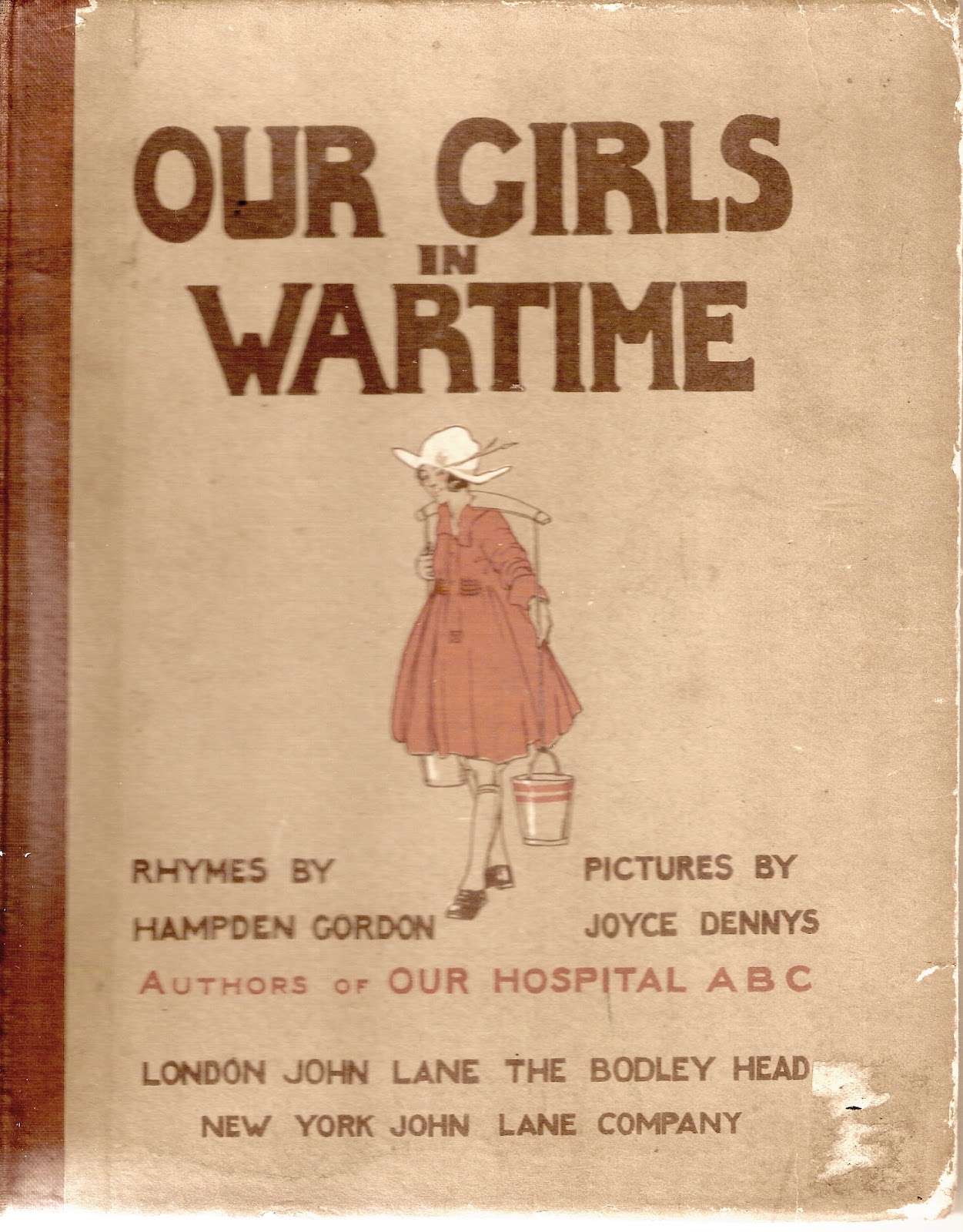
Our Girls in Wartime

Three years ago I added some images from 'Our Hospital ABC' here:

Our Hospital ABC

and was lucky enough recently to find a copy of its sister publication 'Our Girls in Wartime,' again with pictures by Joyce Dennys and rhymes by Hampden Gordon. So here are a couple of the pages with their rhymes:


***


Martha, a Munition-maker
Manufactures shells
Martha's Father is a baker:
Cakes are what HE sells.
Martha swears the shells she makes
Do more damage than his cakes ...
Perhaps.

***


Miranda mixed with all the Nobs;
Her Depot made a million swabs
(War Hospital Supply).
'It was the good hard work,' she said
'That turned my hair this vivid red.
Never, my dears, say dye.'

***

Thursday, 15 March 2012

VADs

Although members of Voluntary Aid Detachments left behind many personal reminiscences and accounts of their time working in hospitals during the Great War, there's not a lot available online that looks at the 'official' side of their service. It's hard to find details of things like pay and conditions of service, where they worked and what they actually did. Also, there are often comments made about 'problems,' but rarely any clear indication of what the problems were. So I've started putting together a few pages about VAD service during the Great War, based mainly on official documents that originated with the British Red Cross Society and are now held online at the Imperial War Museum as part of their Women's Work Collection. All the items on the website are transcriptions of the original documents with photos that I've collected over time. I intend to add a good deal more over time, but the pages can be found here:

Voluntary Aid Detachments